
This document describes the method of using the Varian 225-MS ion trap mass spectrometer and V:Results™ GC/MS software to determine phthalate compounds in plastic toys. These compounds are health hazards in polyvinyl chloride (PVC) toys and have raised significant concerns among safety regulators.
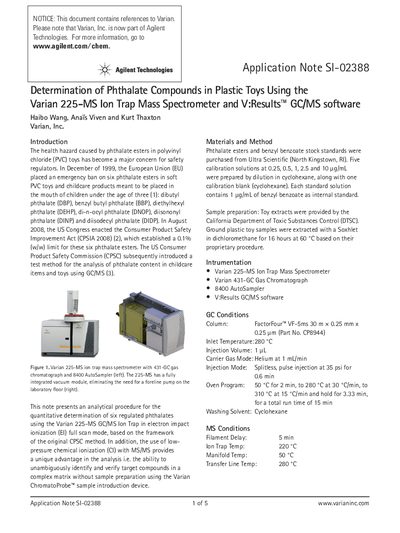
This document presents an analytical procedure for the quantitative determination of six regulated phthalate esters in PVC toys and childcare products. The method utilizes the Varian 225-MS ion trap mass spectrometer with a 431-GC gas chromatograph and 8400 AutoSampler in electron impact ionization full scan mode, based on the Consumer Product Safety Commission (CPSC) framework.
In addition to standard analysis, the note details the use of low-pressure chemical ionization (CI) with MS/MS capabilities. This approach allows for the unambiguous identification of target compounds in complex matrices without extensive sample preparation, utilizing the Varian ChromatoProbe sample introduction device for direct analysis of plastic samples.
| Column | FactorFour VF-5ms 30 m x 0.25 mm x 0.25 pm |
|---|---|
| Inlet Temperature | 280 °C |
| Injection Volume | 1 uL |
| Carrier Gas | Helium at 1 mL/min |
| Transfer Line Temp | 280 °C |
The six regulated phthalate esters are dibutyl phthalate (DBP), benzyl butyl phthalate (BBP), diethylhexyl phthalate (DEHP), di-n-octyl phthalate (DNOP), diisononyl phthalate (DINP), and diisodecyl phthalate (DIDP).
Yes, using low-pressure chemical ionization combined with MS/MS and the ChromatoProbe sample introduction device allows for direct analysis of plastic samples.
Five calibration solutions were prepared at concentrations of 0.25, 0.5, 1, 2.5, and 10 pg/mL.