
Two methods have been developed on the Agilent 7000 Triple Quadrupole GC/MS system for the analysis of polychlorinated biphenyl (PCB) congeners in foodstuffs and animal feed. The methods were shown to give linear response over the required concentration ranges. In addition, quantitative results for dioxin-like PCB (dl-PCB) congeners down to low pg TEQ/g levels and non-dioxin-like PCB (ndl-PCB) congeners at levels below 1 ng/g product were in good agreement with values obtained using a GC-High Resolution mass spectrometer. This application note demonstrates the determination of the 12 dl-PCB comprising eight mono-ortho PCB congeners (# 105, 114, 118, 123, 156, 157, 167 and 189) and four non-ortho PCB congeners (# 77, 81, 126 and 169) as well as the six ndl-PCB congeners (# 28, 52, 101, 138, 153 and 180) that are also known as 'Indicator PCB' congeners.
The document details two developed methods on the Agilent 7000 Triple Quadrupole GC/MS system for analyzing polychlorinated biphenyl (PCB) congeners in foodstuffs and animal feed. The methods provide quantitative results for dioxin-like PCBs down to low pg TEQ/g levels and non-dioxin-like PCBs below 1 ng/g, showing good agreement with GC-High Resolution mass spectrometry values.
The note covers the determination of twelve dioxin-like PCB congeners (including mono-ortho and non-ortho types) and six non-dioxin-like 'Indicator PCB' congeners. It outlines sample preparation procedures involving fat extraction and cleanup steps, followed by analysis using specific GC instrument conditions and MS/MS Multiple Reaction Monitoring mode.
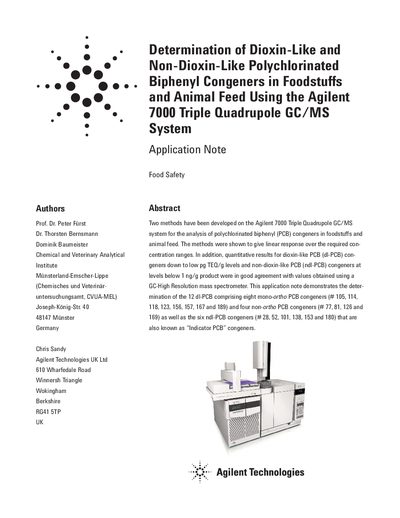
The analysis is performed on an Agilent 7890 GC coupled with an Agilent 7000 Triple Quadrupole GC/MS system.
The method provides quantitative results for dioxin-like PCB congeners down to low pg TEQ/g levels.
The total run time for this analysis is 50.0 minutes.