
Using Fourier transform infrared spectroscopy (FTIR) to analyze short beam shear data to evaluate the effects of thermal exposure on composites.
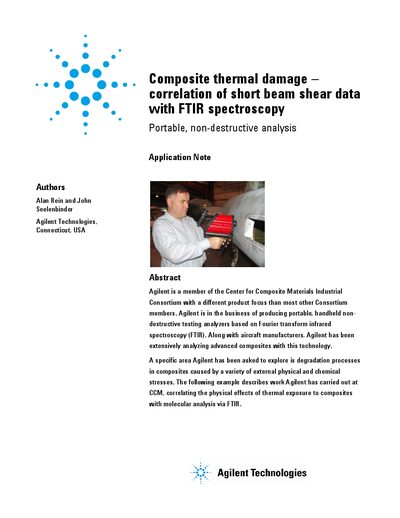
This document describes a study correlating physical degradation of composite materials with molecular analysis using Fourier transform infrared spectroscopy (FTIR). The research utilized the Agilent 4100 ExoScan handheld analyzer to detect chemical changes, specifically oxidation and backbone degradation in epoxy resin, caused by thermal exposure ranging from 350°F to 550°F.
The study correlated these spectral findings with Short Beam Shear (SBS) test results on Cytec 977-3/IM7 epoxy/carbon composite coupons. The analysis demonstrated that FTIR measurements can accurately predict the reduction in physical strength of the bulk composite due to high temperature exposure, achieving an average error of 1.89% against SBS data.
The goal was to determine if the handheld FTIR can detect changes in the molecular structure induced by increasing exposure temperatures and correlate those spectral changes to physical strength.
Each analysis took approximately 30 seconds.
The spectra were measured at 8 cm resolution.