
This application note discusses the method of detecting trace contamination on metal surfaces using the handheld Agilent 4100 ExoScan FTIR to ensure maximum adhesion. The 4100 ExoScan FTIR can identify and quantify the cleanliness of metal surfaces in the field, and detect the presence of organic and some inorganic contaminants. Even very low amounts of contamination can severely decrease the ultimate bond strength, and the highly sensitive 4100 ExoScan can detect trace levels of contaminants.
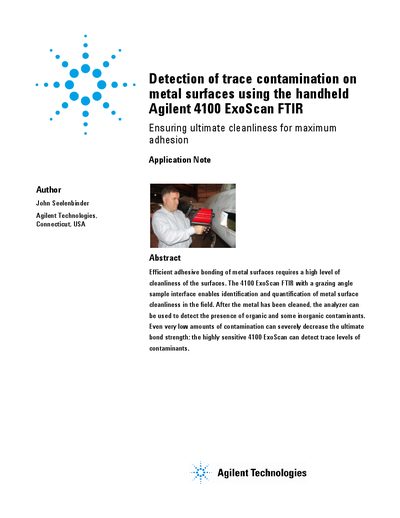
Efficient adhesive bonding of metal surfaces requires a high level of cleanliness. The Agilent 4100 ExoScan FTIR, equipped with a grazing angle sample interface, enables the identification and quantification of surface contaminants in field environments. This document demonstrates how the handheld analyzer can detect trace levels of organic and some inorganic contaminants that might otherwise severely decrease bond strength.
The note details the use of infrared (IR) spectroscopy to measure contamination on metal surfaces. It presents data from tests using a silicone mold release agent on aluminum, showing the instrument's ability to distinguish different contaminant types and providing calculated limits of detection based on spectral analysis.
The calculated limit of detection was 0.17 µg/cm².
The measurement took 10 seconds.
The nominal angle is 82 degrees.