
Agilent Mx3000P QPCR System Application Note for Mycotoxigenic Fungi Detection

This application note describes a rapid method for detecting and quantifying mycotoxigenic fungi using the Stratagene Mx3000P QPCR system.
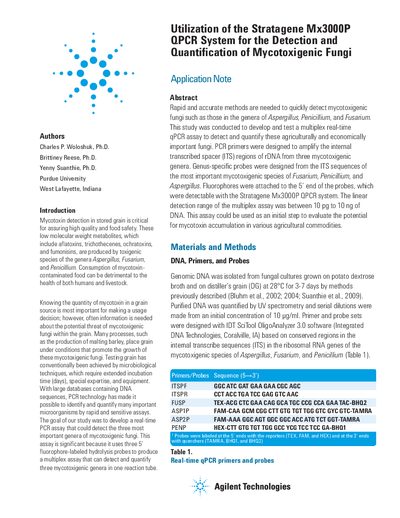

Agilent Mx3000P QPCR System Application Note for Mycotoxigenic Fungi Detection - cover page
Brand
Agilent
Category
Other
Document type
Application Note
Language
English
Pages
4
File format
PDF
File size
80 KB
Published
11 June, 2012
Updated
30 September, 2023
Model
MX3000P
MD5 checksum
87EA838C45308B07D4221CBD7F4D939B

About this manual

This document details the development and testing of a multiplex real-time PCR assay designed to detect and quantify three important genera of mycotoxigenic fungi: Aspergillus, Fusarium, and Penicillium. The assay utilizes genus-specific probes compatible with the Agilent Mx3000P QPCR System to identify these fungi in stored grain and other agricultural commodities rapidly.

What's inside

  • Introduction
  • Materials and Methods
  • PCR Assay
  • Results and Discussion
  • Application: A Case Study
  • Conclusion
  • References

Frequently asked questions

What is the linear detection range of the multiplex assay for mycotoxigenic fungi?

The linear detection range of the multiplex assay is between 10 pg to 10 ng of DNA.

What are the optimum parameters for primer and probe concentration in the PCR reaction?

The optimum parameters are 10 pmol of each primer and 5 pmol of probe per reaction.

What is the annealing and extension temperature for the PCR assay?

The annealing/extension temperature for the PCR assay is 70°C.

Download PDF (80 KB)

More Agilent Manuals


View all Agilent manuals →