
LP3939 is an integrated power amplifier driver designed specifically for Qualcomm's MSM3xxx and MSM5xxx series. It provides an interface to the baseband processor to control two independent power amplifiers in dual band applications. By integrating the necessary discrete components, the LP3939 significantly reduces board space and component cost.
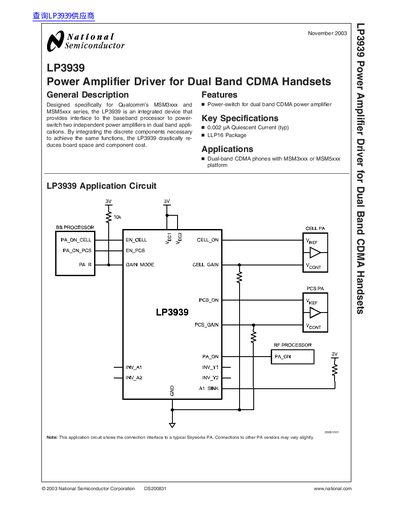
The National Semiconductor LP3939 is an integrated device specifically designed for Qualcomm's MSM3xxx and MSMB6xxx series platforms. It functions as a power-switch for dual band CDMA power amplifiers, integrating discrete components to reduce board space and cost in applications involving dual-band phones with MSM3xxx or MSM5xxx platforms.
The document provides comprehensive technical specifications including absolute maximum ratings, DC electrical characteristics such as quiescent current (0.002 pA typical), and AC propagation delays. It includes connection diagrams, pin descriptions for the LLP16 package, truth tables for PA enables and gain modes, and physical dimensions for the 16-lead plastic quad package.
| Quiescent Current (typ) | 0.002 pA |
|---|---|
| Package Type | LLP16 Package |
| Operating Temperature Range | -40°C to +85°C |
It is designed specifically for Qualcomm's MSM3xxx and MSMB6xxx series.
The typical quiescent current is 0.002 pA.