
This document describes the advantages and disadvantages of copper and molybdenum sources on a dual source SuperNova diffractometer, and compares the two sources in terms of data collection and data processing.
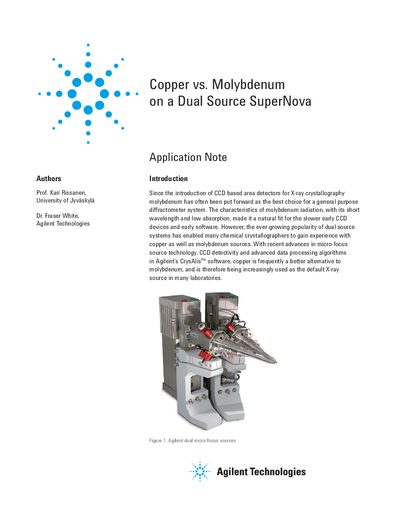
The document evaluates the performance of Copper versus Molybdenum as X-ray sources using an Agilent SuperNova diffractometer equipped with a large area Atlas CCD detector. It highlights that while Molybdenum was traditionally preferred, advances in micro-focus source technology and software have made Copper a frequent alternative.
An experiment was conducted to compare data collection efficiency within a one-hour time limit. The results indicate that the Copper dataset achieved better resolution (0.84 A) compared to the Molybdenum dataset (1.06 A), demonstrating superior diffraction intensity and data quality for routine chemical crystallography.
The wavelength used for the Molybdenum dataset was 0.7107 A.
The copper dataset diffracted beyond the intended target, achieving a minimum resolution of 0.84 A.