
The ML4872 is a continuous conduction boost regulator designed for DC to DC conversion in multiple cell battery powered systems. Continuous conduction allows the regulator to maximize output current for a given inductor. The maximum switching frequency can exceed 200kHz, allowing the use of small, low cost inductors. The ML4872 is capable of start-up with input voltages as low as 1.8V and is available in 5V and 3.3V output versions with an output voltage accuracy of ±3%. An integrated synchronous rectifier eliminates the need for an external Schottky diode and provides a lower forward voltage drop, resulting in higher conversion efficiency. In addition, low quiescent battery current and variable frequency operation result in high efficiency even at light loads. The ML4872 requires only one inductor and two capacitors to build a very small regulator circuit capable of achieving conversion efficiencies approaching 90%. The SHDN input allows the user to stop the regulator from switching and powers down the control circuitry.
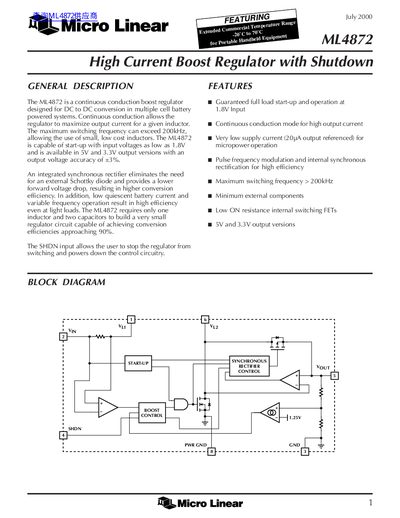
The ML4872 is a high current boost regulator designed for DC to DC conversion in multiple cell battery powered systems. It features continuous conduction mode and an integrated synchronous rectifier to maximize output current and efficiency while minimizing external components.
Available in 5V and 3.3V output versions, the device supports start-up with input voltages as low as 1.8V. Key characteristics include a maximum switching frequency exceeding 200kHz, very low quiescent supply current for micropower operation, and an internal shutdown function.
| Maximum Switching Frequency | > 200kHz |
|---|---|
| Minimum Start-up Voltage | 1.8V |
| Output Versions | 5V and 3.3V |
| Quiescent Current (SHDN = Vin) | 15 to 22 µA |
| Peak Switch Current Limit | Approximately 1.5A |
The ML4872 is available in 5V and 3.3V output versions.
The regulator can start up with input voltages as low as 1.8V.
No, it has an integrated synchronous rectifier that eliminates the need for an external Schottky diode.