
This article discusses the application of linear regulators to post-regulate switching regulator outputs. Linear regulators offer benefits such as improved stability, accuracy, transient response, and lowered output impedance. However, they encounter difficulties in handling the ripple and spikes generated by switching regulators, particularly at higher frequencies. The article focuses on the impact of residual input-derived high-frequency components on the output of linear regulators.
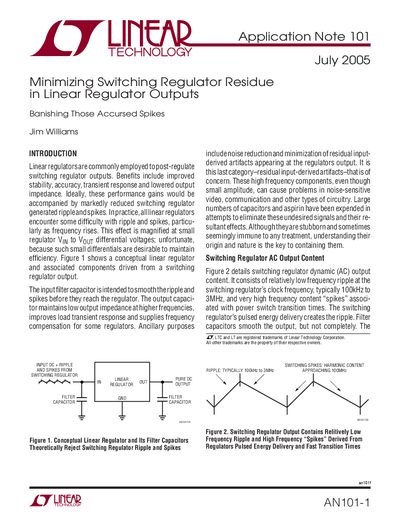
Linear regulators are commonly used to post-regulate switching regulator outputs, offering benefits like improved stability and lower output impedance. However, they often struggle with high-frequency ripple and spikes generated by the upstream switching regulator, particularly when the voltage differential is small. These residual artifacts can cause issues in noise-sensitive circuitry such as video and communication systems.
The document details the nature of these disturbances, distinguishing between low-frequency ripple and very high-frequency spikes that approach 100MHz. It explains how parasitic elements within the regulator and filter capacitors limit rejection performance at higher frequencies. The text also describes a hardware simulator circuit designed to independently generate and test responses to specific ripple and spike parameters.
The ripple typically occurs at frequencies between 100kHz and 3MHz.
Spikes often have harmonic content approaching 100MHz.