
This article describes the bias voltage and current sense circuits for avalanche photodiodes (APDs) used in fiber optic systems. The APD module contains an APD and a trans-impedance amplifier, which converts the optical signal into an electrical signal. The APD requires a relatively high bias voltage to operate, typically ranging from 20V to 90V. Additionally, monitoring the APD's average current can indicate the optical signal strength and be used in conjunction with feedback techniques to maintain optimal signal levels.
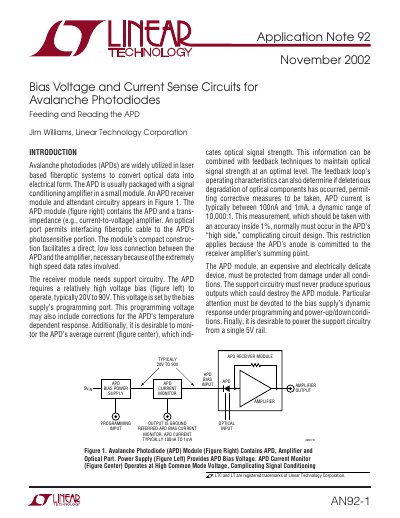
Avalanche photodiodes (APDs) are used in laser-based fiberoptic systems to convert optical data into electrical form. The document addresses the design challenges of providing a high-voltage bias (typically 20V to 90V) and monitoring APD current with high accuracy over a wide dynamic range, while operating from a single low voltage rail.
The APD requires a relatively high voltage bias to operate, typically 20V to 90V.
APD current is typically between 100nA and 1mA.
It is desirable to power the support circuitry from a single 5V rail.