
Analog Devices AN95 Simple Circuitry for Cellular Telephone/Camera Flash Illumination Application Note

This document introduces the simple circuitry for cellular telephone/camera flash illumination, including LED and flashlamp two schemes, and detailed explanation of the flashlamp working principle and characteristics.
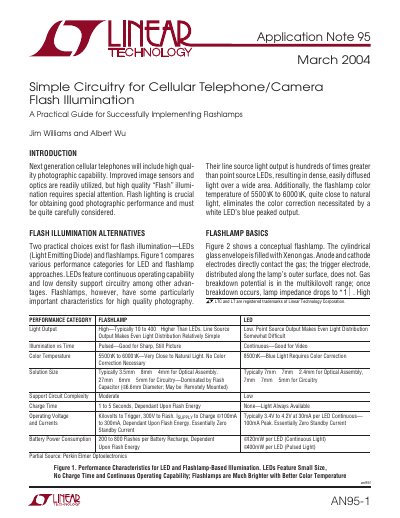

Analog Devices AN95 Simple Circuitry for Cellular Telephone/Camera Flash Illumination Application Note - cover page
Brand
Linear Technology
Document type
Application Note
Language
English
Pages
12
File format
PDF
File size
649 KB
Published
05 June, 2012
Updated
30 September, 2023
MD5 checksum
1B6483FC694E2C8BB86719F470E5B8B3

About this manual

The document discusses the requirements for high-quality photographic capability in next-generation cellular telephones. It compares two practical choices for flash illumination: Light Emitting Diodes (LEDs) and flashlamps. The text highlights that while LEDs offer continuous operation, flashlamps provide superior line source light output and a color temperature closer to natural light.

What's inside

  • Introduction
  • Flash Illumination Alternatives
  • Flashlamp Basics
  • Support Circuitry
  • Flash Capacitor Charger Considerations

Frequently asked questions

What is the typical operating voltage range required to trigger a flashlamp?

The system requires kilovolts to trigger the lamp and approximately 300V to supply the charge for the flash.

How long does it typically take to recharge the flash capacitor?

Charge times range from 1 to 5 seconds depending on available input power and circuit characteristics.

What is the typical output voltage produced by the flash capacitor charger?

The charger produces a regulated DC output of typically 300V.

Download PDF (649 KB)

More Linear Technology Manuals


View all Linear Technology manuals →