
delta sigma adc bridge measurement techniques
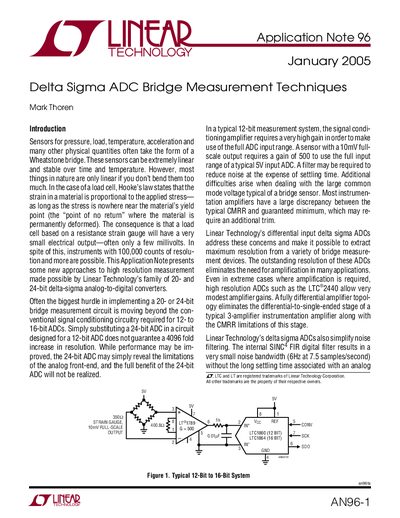
The document explains that while Wheatstone bridge sensors are linear and stable, they often produce very small electrical outputs. It details how Linear Technology's family of 20- and 24-bit delta-sigma analog-to-digital converters enables high-resolution measurement without the need for complex signal conditioning circuitry typically required for lower-bit ADCs.
The note provides specific application examples, such as a low-cost precision altimeter using the LTC2411 with a piezoresistive barometric pressure sensor. It also discusses how to increase resolution using amplifiers like the LTC2051 and analyzes the effects of various gains on circuit performance, noting that excessive gain can lead to measurement errors due to amplifier bias current.
A typical strain gauge sensor has a very small electrical output, often only a few millivolts.
A sensor with a 10mV full-scale output requires a gain of 500 to use the full input range of a typical 5V input ADC.