
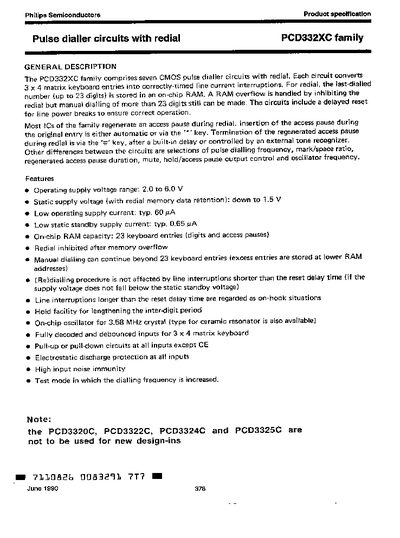
The PCD332XC family comprises seven CMOS pulse dialer circuits with redial capability. Each device converts 3×4 matrix keyboard entries into correctly‑timed line current interruptions and stores the last‑dialed number (up to 23 digits) in on‑chip RAM.
The datasheet provides electrical characteristics, pin‑out diagrams, package outlines, functional descriptions, and timing data for each variant (PCD3320C‑PCD3327C), including supply voltage ranges, current consumption, oscillator options, and access‑pause features.
| Operating supply voltage range | 2.0 to 6.0 V |
|---|---|
| Static supply voltage (memory retention) | down to 1.5 V |
| Low operating supply current (typ.) | 60 µA |
| Low static standby supply current (typ.) | 0.65 µA |
| On‑chip RAM capacity | 23 keyboard entries |
| Number of pins (common package) | 18 pins |
The devices operate from 2.0 V to 6.0 V.
The RAM can hold up to 23 keyboard entries (digits and access pauses).
Typical low operating supply current is about 60 µA.
The oscillator input is on the OSC IN pin.