
NJG1521PE1 is an antenna switch IC for a digital cellular phone of 800MHz and 1.5GHz band. It features low voltage operation, low current consumption, and low insertion loss. It is packaged in an ultra-small and thin FFP24-E1 package.
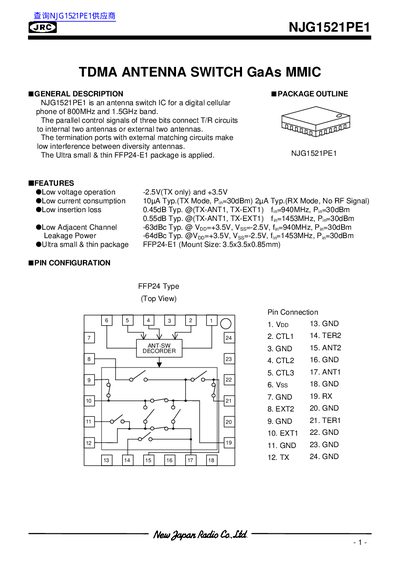
The NJG1521PE1 is a GaAs MMIC antenna switch IC designed for digital cellular phones operating in the 800 MHz and 1.5 GHz bands. It provides three‑bit parallel control to select between two internal or external antennas while maintaining low interference.
The document details electrical characteristics, absolute maximum ratings, pin configuration, typical performance curves, recommended PCB layout, parts list and handling precautions for the ultra‑small FFP24‑E1 package.
| Positive supply voltage (Vop) typical | 3.5 V |
|---|---|
| Positive supply voltage (Vop) maximum | 5.0 V |
| Insertion loss (TX‑ANT1, 800 MHz) | 0.45 dB typ. |
| Switching time | 120 – 500 ns |
| Power dissipation | 600 mW |
| Frequency range (800 MHz band) | 885 – 960 MHz |
The positive supply (Vop) operates typically at 3.5 V with a maximum of 5.0 V, while the negative supply (Vss) is typically –2.5 V and must not go below –4.0 V.
The typical insertion loss for the TX‑ANT1 path at 800 MHz is 0.45 dB.
The switching time is between 120 ns and 500 ns depending on the control signal.