
RPI-5100 is a photointerrupter which is applied to optical control equipment, facsimiles and plain paper copiers. It features a compact structure, minimal influence from stray light and an actuator mount.
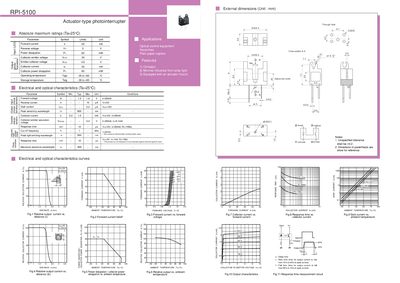
The RPI-5100 is an actuator‑type photointerrupter designed for use in optical control equipment such as plain‑paper copiers and other electronic devices. It features a compact package, minimal stray‑light influence, and an actuator mount.
Key specifications include a forward current of 50 mA, collector‑emitter voltage rating of 30 V, power dissipation of 80 mW, and an operating temperature range of –25 °C to +85 °C. Optical characteristics such as peak sensitivity wavelength (800 nm) and response time (10 ps) are also detailed.
| Forward current (IF) | 50 mA |
|---|---|
| Collector‑emitter voltage (VCEO) | 30 V |
| Emitter‑collector voltage (VECO) | 45 V |
| Collector current (IC) | 30 mA |
| Power dissipation (Po) | 80 mW |
| Operating temperature range | -25 °C to +85 °C |
| Storage temperature range | -30 °C to +85 °C |
| Peak sensitivity wavelength | 800 nm |
| Maximum sensitivity wavelength | 800 nm |
| Response time (tr) | 10 ps |
The forward current (IF) is rated at 50 mA.
It operates from –25 °C to +85 °C.
The device is rated for a collector‑emitter voltage of 30 V.
Its maximum power dissipation is 80 mW.