
2SB1198K is a low frequency transistor with a rated voltage of 80V and a rated current of 0.5A. Its features are low voltage distortion, high breakdown voltage, and compatibility with 2SD1782K.
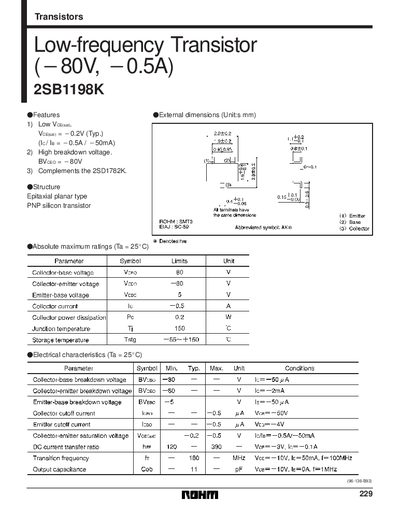
The 2SB1198K is a low‑frequency PNP silicon transistor with a typical emitter‑base voltage drop of -0.2 V and a collector‑emitter breakdown voltage of -80 V. It is designed for applications requiring up to 0.5 A collector current and features a high breakdown voltage of 80 V.
The document lists absolute maximum ratings such as a collector power dissipation of 0.2 W, junction temperature up to 150 °C, and storage temperature range of -55 °C to +150 °C. Packaging specifications, ordering quantities, and characteristic curves are also provided for design reference.
| Collector‑base voltage (Vcbo) | -80 V |
|---|---|
| Collector‑emitter voltage (Vceo) | -80 V |
| Emitter‑base voltage (Vebo) | -5 V |
| Collector current (Ic) | -0.5 A |
| Collector power dissipation (Pc) | 0.2 W |
| Junction temperature (Tj) | 150 °C |
| Storage temperature (Tstg) | -55 °C to +150 °C |
The maximum collector‑emitter voltage is -80 V.
The typical emitter‑base voltage drop is -0.2 V.
A basic order consists of 3000 pieces.
The storage temperature range is -55 °C to +150 °C.