
KP 1830 is an AC and pulse film foil capacitor produced by Vishay Roederstein. It uses polypropylene film and aluminum foil, with an rated voltage range of 63 to 630V and a rated working temperature of 100°C.
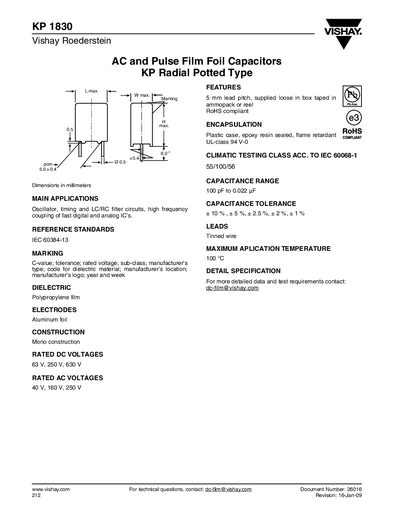
The KP 1830 series are AC and pulse film foil capacitors designed for oscillator, timing, LC/RC filter circuits, and high‑frequency coupling of fast digital and analog ICs. They feature a polypropylene film dielectric, aluminum foil electrodes, and a mono‑construction.
The document lists rated DC voltages of 63 V, 250 V, and 630 V, rated AC voltages of 40 V, 160 V, and 250 V, a capacitance range from 100 pF to 0.022 µF, and a 5 mm lead pitch. It also covers packaging options, mounting methods, thermal characteristics, and inspection requirements.
| Dielectric | Polypropylene film |
|---|---|
| Electrodes | Aluminum foil |
| Construction | Mono construction |
| Rated DC Voltage | 63 V, 250 V, 630 V |
| Rated AC Voltage | 40 V, 160 V, 250 V |
| Capacitance Range | 100 pF to 0.022 µF |
| Capacitance Tolerance | 10 %, +5 %, 42.5 %, +2 %, 41 % |
| Lead Pitch | 5 mm |
| Leads | Tinned wire |
| Storage Temperature Range | -25 °C to +40 °C |
| Climatic Testing Class | 55/100/56 |
The KP 1830 is available with rated DC voltages of 63 V, 250 V, and 630 V.
The capacitors use a 5 mm lead pitch.
They use a polypropylene film dielectric.