
ISL28270, ISL28273, ISL28470 Micropower, Single Supply, Rail-to-Rail Input and Output (RRIO) Instrumentation Amplifiers with IREC
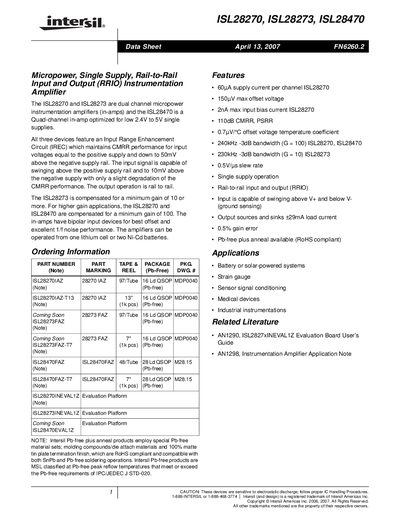
The ISL28270 and ISL28273 are dual‑channel micropower instrumentation amplifiers, while the ISL28470 is a quad‑channel version. All devices operate from a single low‑voltage supply (2.4 V to 5 V), provide rail‑to‑rail input and output, and include an Input Range Enhancement Circuit for high common‑mode performance.
Key specifications include low offset voltage, low input bias current, high CMRR, and up to 29 mA output drive. The parts are offered in 16‑lead and 28‑lead QSOP packages, with additional SSOP and QSOP family dimensions provided. Ordering information, pinouts, absolute maximum ratings, and typical performance curves are included.
| Supply Voltage Range | 2.4 V to 5.0 V |
|---|---|
| Gain Error | 0.5 % (typical) |
| Output Current | +29 mA load current |
| Bandwidth (G=100) | 240 kHz (-3 dB) |
| Input Offset Voltage | 150 µV max |
The devices operate from 2.4 V up to 5.0 V.
They can source and sink up to +29 mA load current.
They are offered in 16‑lead QSOP, 28‑lead QSOP, and also in SSOP and QSOP family variants.
Typical gain error is 0.5 %.