
The ISL6431 is a high efficiency, fixed frequency, synchronous buck PWM controller. It is designed for use in applications that convert 5V to lower distributed voltages required for set-top box, cable modem, DSL modem and residential home gateway core processor, memory and peripheral power supplies. This device makes simple work out of implementing a complete control and protection scheme for a DC-DC stepdown converter. Designed to drive N-channel MOSFETs in a synchronous buck topology, the ISL6431 integrates the control, output adjustment, monitoring and protection functions into a single 8-pin package. The ISL6431 provides simple, single feedback loop, voltage- mode control with fast transient response. The output voltage can be precisely regulated to as low as 0.8V, with a maximum tolerance of ±1.5% over temperature and line voltage variations. A fixed frequency oscillator reduces design complexity, while balancing typical application cost and efficiency. The error amplifier features a 15MHz gain-bandwidth product and 6V/µs slew rate which enables high converter bandwidth for fast transient performance.
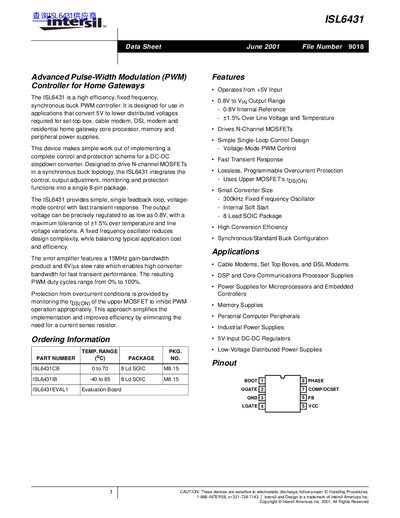
The ISL6431 is a high‑efficiency, fixed‑frequency synchronous buck PWM controller designed for 5 V input applications such as set‑top boxes, cable modems, DSL modems and residential gateway power supplies. It integrates control, output adjustment, monitoring and protection functions in an 8‑lead SOIC package.
Key features include a 0.8 V to Vin output range, 300 kHz fixed‑frequency oscillator, programmable over‑current protection that uses the upper MOSFET’s on‑resistance, and a 15 MHz gain‑bandwidth error amplifier. The datasheet also covers layout considerations, component selection, and detailed pin functions for designers.
| Input Voltage | +5 V |
|---|---|
| Output Voltage Range | 0.8 V to Vin |
| Fixed Switching Frequency | 300 kHz |
| Overcurrent Set Current Source | 20 µA |
The controller operates from a +5 V input.
It monitors the voltage drop across the upper MOSFET’s on‑resistance (DS(ON)) using the COMP/OCSET pin, eliminating the need for a separate current‑sense resistor.
The device uses a 300 kHz fixed‑frequency oscillator.
It is offered in an 8‑lead SOIC package.