
This document describes the timing specifications and technical characteristics of the AD667 model product, including data validity, address validity, CS pulse width, data hold time, output voltage settling time, etc. In addition, it also introduces the features of the AD667J and AD667K models, such as digital inputs, transfer characteristics, accuracy, drift, conversion speed, and analog output range.
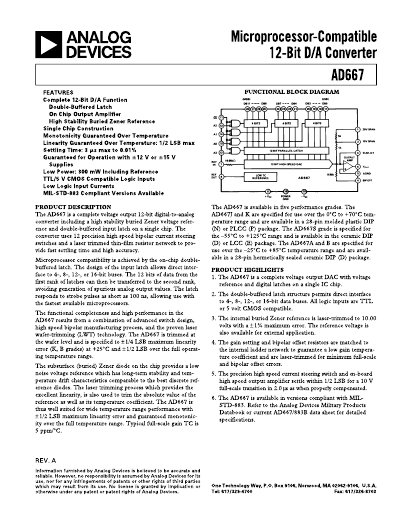
The AD667 is a 12‑bit digital‑to‑analog converter offering true 12‑bit performance over a wide temperature range. It provides multiple output voltage ranges (±10 V, ±5 V, ±2.5 V, 0‑10 V, 0‑5 V) and includes an internal low‑noise reference.
The document contains timing specifications, digital input characteristics, analog output details, power‑supply requirements, grounding rules, and recommended circuit configurations for both unipolar and bipolar operation.
| Resolution | 12 bits |
|---|---|
| Gain Error | ±0.1 % of FSR |
The threshold of the digital input circuitry is set at 1.4 V and does not vary with supply voltage.
Turn all bits OFF and adjust the 100 Ω trimmer R1 until the output reads –5.000 V.