
The 64-position OTP digital potentiometer AD5171 is a low-cost digital potentiometer that can be programmed via an I2C-compatible digital interface. The product has four resistance values available: 5 kΩ, 10 kΩ, 50 kΩ, and 100 kΩ, and can be used for system calibrations and electronic level settings.
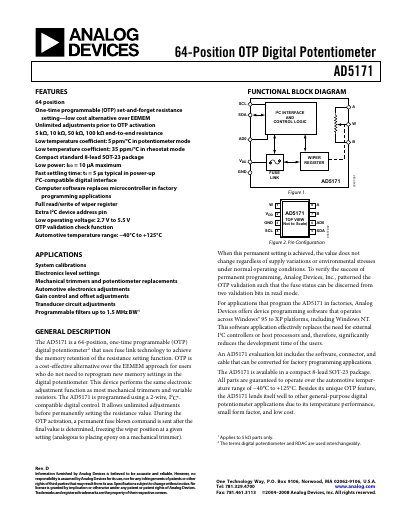
The AD5171 digital potentiometer provides 64 programmable positions using fuse‑link OTP technology. It features an I²C‑compatible two‑wire interface, low supply current (10 µA typical), and a compact 8‑lead SOT‑23 package, making it suitable for system calibration, automotive electronics, and other applications where permanent resistance settings are required.
The device operates from 2.7 V to 5.5 V, supports a temperature range of –40 °C to +125 °C, and offers 6‑bit resolution with low temperature coefficients. Detailed specifications, timing characteristics, pin functions, and evaluation board information are provided for designers.
| Number of positions | 64 |
|---|---|
| Interface | I²C‑compatible digital interface |
| Operating temperature range | –40 °C to +125 °C |
| Resolution | 6 bits |
It is programmed using a 2‑wire I²C‑compatible digital control, allowing unlimited adjustments before the OTP fuse is blown to set the resistance permanently.
The AD5171 is supplied in a compact 8‑lead SOT‑23 package.