
VEMI255A-HS3 is a 2-channel EMI filter with ESD protection from Vishay Semiconductors. It is packed in LLP75-6A package and features low leakage current, 50 Ω line resistance and 100 MHz typical cutoff frequency. The product complies with RoHS 2002/95/EC and WEEE2002/96/EC standards.
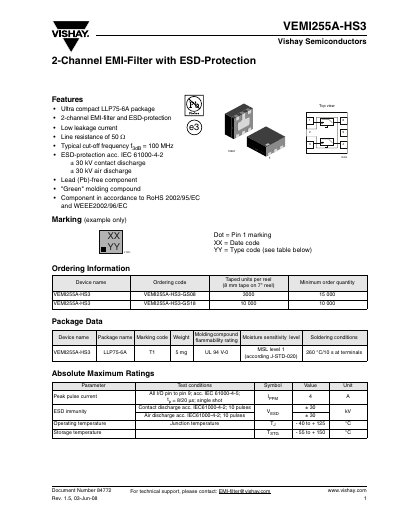
The VEMI255A‑HS3 EMI filter provides two independent filter channels that can be used as either inputs or outputs. Each channel includes bi‑directional Z‑diodes for ESD protection and a low‑pass filter formed by the line resistance and diode capacitance, allowing low‑frequency signals to pass while high‑frequency noise is shunted to ground.
The device is supplied in an ultra‑compact LLP75‑6A package, is lead‑free, RoHS‑compliant, and meets IEC 61000‑4‑2 ESD standards with ±30 kV protection. Electrical characteristics such as line resistance (50 Ω), cut‑off frequency (100 MHz), and input capacitance (60 pF at 0 V) are specified for design integration. This manual is written in Chinese.
| Number of channels | 2 |
|---|---|
| Line resistance | 50 Ω |
| Cut‑off frequency (f3dB) | 100 MHz |
| ESD clamping voltage | ±30 kV |
| Input capacitance (CIN) at 0 V | 60 pF |
| Reverse breakdown voltage (VBR) | 6 V |
The typical cut‑off frequency is 100 MHz.
It provides two independent filter channels.
The line resistance is 50 Ω.