
VISHAY IL205AT/206AT/207AT/208AT is an optocoupler with high BVCEO(70V), isolation test voltage(3000VRMS), industry standard SOIC-8A surface mount package, compatible with dual wave, vapor phase and infrared reflow soldering.
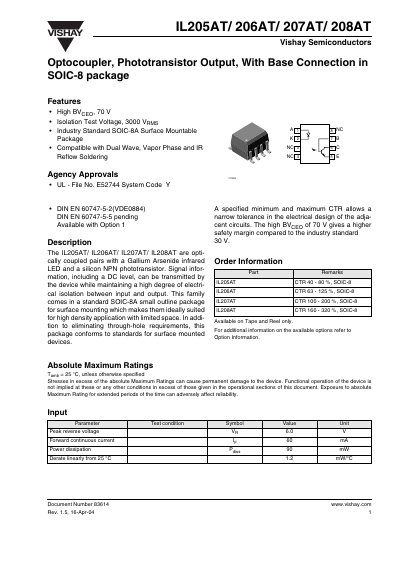
The Vishay IL205AT‑IL208AT family are optically coupled devices with a GaAs infrared LED and a silicon NPN phototransistor, offered in a standard SOIC‑8A surface‑mount package for high‑density applications. They provide high isolation (70 V BVCEO) and a range of current transfer ratios (CTR) suitable for various circuit designs.
The datasheet lists absolute maximum ratings, electrical characteristics such as forward voltage, power dissipation, and isolation test voltage, as well as switching performance and package dimensions. It also includes Vishay's ozone‑depleting substances policy for compliance information.
| Collector‑emitter breakdown voltage (BVCEO) | 70 V |
|---|---|
| Current Transfer Ratio (CTR) – IL207AT | 100‑200 % |
| Power dissipation (Pdiss) | 150 mW |
| Isolation test voltage (VISO) | 3000 VRMS |
| Package type | SOIC‑8A surface‑mount |
The device is rated for a collector‑emitter breakdown voltage of 70 V.
The IL205AT has a current transfer ratio ranging from 40 % to 80 %.
A soldering time of 10 seconds at 260 °C is specified.