
The MAX9242/MAX9244/MAX9246/MAX9254 deserialize three LVDS serial-data inputs into 21 single-ended LVC- MOS/LVTTL outputs. They feature spread-spectrum capability to reduce EMI by spreading the output data and clock frequency over a specified range.
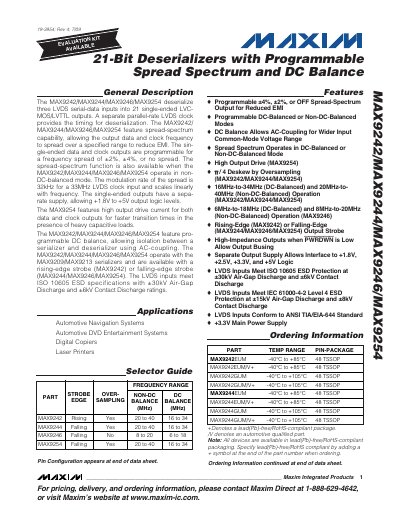
The Maxim MAX9242/9244/9246/9254 family are 21‑bit deserializers that convert three LVDS serial‑data inputs into single‑ended LVC‑MOS/LVTTL outputs. They feature programmable spread‑spectrum (±2 % or ±4 % or off) and programmable DC‑balance, allowing operation in both DC‑balanced and non‑DC‑balanced modes. Output logic levels are selectable from 1.8 V to 5 V, and the MAX9254 version provides higher output drive for heavy capacitive loads.
The devices are offered in a 48‑pin TSSOP package, operate from –40 °C to +105 °C, and meet ISO 10605 and IEC 61000‑4‑2 ESD specifications. Detailed electrical characteristics, timing diagrams, and layout guidelines are provided for system designers.
| Number of output bits | 21 single‑ended LVC‑MOS/LVTTL outputs |
|---|---|
| Package | 48‑pin TSSOP |
| Operating temperature range | -40 °C to +105 °C |
| Power‑supply range (VCC) | 3.0 V to 3.6 V |
| Output‑supply range (VCCO) | 1.8 V to 5.5 V |
| Spread‑spectrum options | Programmable ±2 % or ±4 % or OFF |
| ESD protection (air‑gap) | ±30 kV |
MAX9242 uses a rising‑edge strobe, while MAX9244, MAX9246 and MAX9254 use a falling‑edge strobe.
The LVDS inputs meet ISO 10605 (±30 kV air‑gap, ±6 kV contact) and IEC 61000‑4‑2 (±15 kV air‑gap, ±8 kV contact) standards.