
The MAX2165 is a direct-conversion tuner IC designed for handheld digital video broadcast (DVB-H) applications. The tuner covers a 470 MHz to 780 MHz input frequency range and features an I/Q baseband interface. The MAX2165’s direct-conversion architecture eliminates the need for an IF-SAW filter, allowing for reduced bill of materials cost. The design integrates a variable-gain, low-noise amplifier (LNA); a notch filter; an RF tracking filter; a quadrature mixer; a power detector; programmable baseband lowpass channel-selection filters; baseband variable-gain amplifiers (VGA); DC offset correction circuitry; and a complete fractional-N frequency synthesizer. The part is programmable through a 2-wire I2C-compatible serial interface. The MAX2165 integrates a tuneable notch filter. This filter is designed to notch out interfering signals in the 830 MHz to 950 MHz frequency range to allow for operation in the presence of large cellular signals. Programmable baseband channel-selection filters allow for operation with 7 MHz and 8 MHz channels. Digital DC offset correction circuitry supports time-sliced operation by minimizing power-up time delay. The fractional-N synthesizer reduces VCO lock time and minimizes close-in phase noise, eliminating the need for power-hungry, phase-noise reduction algorithms. The MAX2165 is available in a tiny, 5mm x 5mm x 0.8mm, 28-pin thin QFN package with an exposed pad- dle. It is specified for operation over the -40°C to +85°C
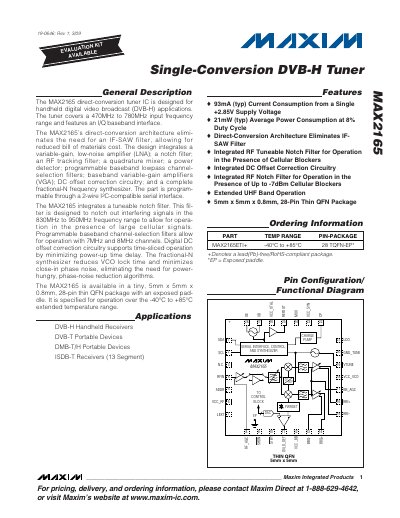
The MAX2165 is a direct‑conversion tuner IC designed for handheld digital video broadcast (DVB‑H) applications. It covers a 470 MHz to 780 MHz input frequency range, provides an I/Q baseband interface, and integrates a low‑noise amplifier, notch filter, RF tracking filter, quadrature mixer, power detector, programmable baseband filters, VGA, DC offset correction, and a fractional‑N synthesizer. Programming is performed via a 2‑wire I²C‑compatible serial interface.
The device is supplied in a 5 mm × 5 mm × 0.8 mm 28‑pin thin QFN package and operates from –40 °C to +85 °C. Electrical specifications include a supply voltage of 2.75 V–3.30 V, typical supply current of 93 mA with the LNA on, and a shutdown current of 20 µA. Detailed pin descriptions, register maps, and performance graphs are provided throughout the document.
| Operating Frequency Range | 470 MHz – 780 MHz |
|---|---|
| Supply Voltage | 2.75 V – 3.30 V |
| Shutdown Current | 20 µA |
| Operating Temperature Range | -40 °C to +85 °C |
| Package | 5 mm × 5 mm × 0.8 mm 28‑pin thin QFN |
The MAX2165 is programmed through a 2‑wire I²C‑compatible serial interface.
It operates from –40 °C up to +85 °C.
The device is offered in a 5 mm × 5 mm × 0.8 mm 28‑pin thin QFN package.