
The MAX9947 is an AISG-compliant, fully integrated transceiver. The MAX9947 receiver offers a typical dynamic range of 20dB and integrates a bandpass filter that operates in the 2.176MHz frequency with a narrow 200kHz bandwidth. The MAX9947 transmitter integrates a bandpass filter that is compliant with the AISG spectrum emission pro- file. It can modulate OOK signals up to 115.2kbps. The output power can be varied with external resistors from +7dBm to +12dBm to compensate for loss in the external circuitry and cabling. The MAX9947 also features a direction output to facilitate the RS-485 bus arbitration in tower-mounted equipment. The MAX9947 is available in a small, 3mm x 3mm 16-pin TQFN and is rated for operation in the -40°C to +85°C temperature range.
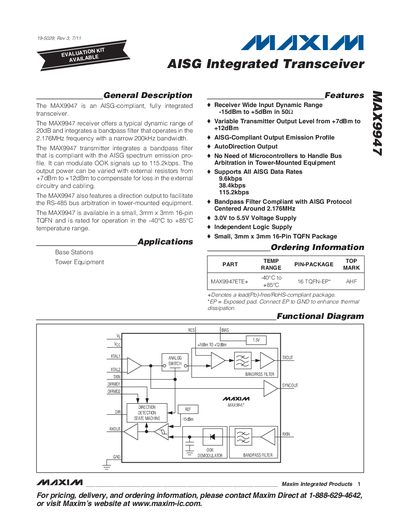
The MAX9947 is an AISG‑compliant integrated transceiver that combines a receiver and transmitter in a single 16‑pin TQFN package. It provides a typical receiver dynamic range of 20 dB, supports OOK modulation up to 115.2 kbps, and includes a direction output for RS‑485 bus arbitration in tower‑mounted equipment. Typical applications are base stations and tower equipment.
The device operates from 3.0 V to 5.5 V supply voltage, offers a variable transmitter output level from +7 dBm to +12 dBm, and is rated for –40 °C to +85 °C. It is supplied in a 3 mm × 3 mm 16‑pin TQFN package and includes integrated band‑pass filters centered at 2.176 MHz. Detailed electrical characteristics, package dimensions, and revision history are provided.
| Receiver Wide Input Dynamic Range | -15 dBm to +5 dBm |
|---|---|
| Variable Transmitter Output Level | +7 dBm to +12 dBm |
| Supply Voltage (Vcc) | 3.0 V to 5.5 V |
| Supply Current (Ioc) | 23 mA to 35 mA |
| Logic Supply Voltage (VL) | 1.6 V to 5.5 V |
| Package | 3 mm × 3 mm 16‑pin TQFN |
| Operating Temperature Range | -40 °C to +85 °C |
The receiver offers a typical dynamic range of 20 dB.
It supports 9.6 kbps, 38.4 kbps, and 115.2 kbps.
The device operates from 3.0 V to 5.5 V supply voltage.
It is offered in a 3 mm × 3 mm 16‑pin TQFN package.