
The MAX1002 is a dual, 6-bit analog-to-digital converter (ADC) that combines high-speed, low-power operation with a user-selectable input range, an internal reference, and a clock oscillator. The dual, parallel ADCs are designed to convert in-phase (I) and quadrature (Q) analog signals into two 6-bit offset-binary-coded digital outputs at sampling rates up to 60Msps while achieving typical integral nonlinearity (INL) and differential nonlinearity (DNL) of ±1/4LSB. The ability to interface directly with baseband I and Q signals makes the MAX1002 ideal for use in direct-broadcast satellite, VSAT, and QAM16 demodulation applications. The MAX1002 input amplifiers feature true differential inputs, a 55MHz -0.5dB analog bandwidth, and user-programmable input full-scale ranges of 125mVp-p, 250mVp-p, or 500mVp-p. With an AC-coupled input signal, matching performance between input channels is typically 0.1dB gain, 1/4LSB offset, and 0.5° phase. Dynamic performance is 5.85 effective number of bits (ENOB) with a 20MHz analog input signal, or 5.78 ENOB with a 50MHz input signal. The MAX1002 operates with a single +5V power supply and provides TTL-compatible digital outputs. The device is available in the commercial temperature range (0°C to +70°C) and comes in a 36-pin SSOP package.
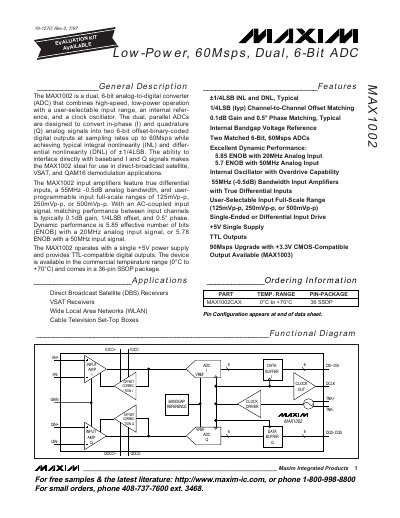
The MAX1002 is a dual, 6‑bit analog‑to‑digital converter that combines high‑speed, low‑power operation with a user‑selectable input range, an internal reference, and a clock oscillator. It converts I and Q analog signals into two 6‑bit offset‑binary outputs at sampling rates up to 60 Msps, achieving typical INL and DNL of ±1/4 LSB.
Typical applications include direct‑broadcast satellite receivers, VSAT, WLAN and cable‑TV set‑top boxes. Key features are true differential inputs, 55 MHz bandwidth, three programmable full‑scale ranges (125 mVp‑p, 250 mVp‑p, 500 mVp‑p), single‑supply +5 V operation, TTL‑compatible outputs, and a 36‑pin SSOP package.
| Maximum sampling rate | 60 Msps |
|---|---|
| Input full‑scale range | 125 mVp‑p, 250 mVp‑p, 500 mVp‑p |
| Supply voltage | +5 V (single‑supply) |
| Package | 36‑pin SSOP |
| Effective Number of Bits (ENOB) | 5.85 bits @ 20 MHz |
| Operating temperature range | 0 °C to +70 °C |
The MAX1002 can sample at up to 60 Msps.
It operates from a single +5 V supply.
The device offers 125 mVp‑p, 250 mVp‑p, and 500 mVp‑p full‑scale ranges.
It is supplied in a 36‑pin SSOP package.