
The MAX1436B is a low-power, high-performance analog-to-digital converter (ADC) from TI that features fully differential inputs, a pipelined architecture, and digital error correction incorporating a fully differential signal path. This ADC is optimized for low-power and high-dynamic performance in medical imaging instrumentation and digital communications applications. The MAX1436B operates from a 1.8V sin- gle supply and consumes only 743mW (93mW per channel) while delivering a 69.9dB (typ) signal-to-noise ratio (SNR) at a 5.3MHz input frequency. In addition to low operating power, the MAX1436B features a low- power standby mode for idle periods. An internal 1.24V precision bandgap reference sets the full-scale range of the ADC. A flexible reference struc- ture allows the use of an external reference for applica- tions requiring increased accuracy or a different input voltage range. The reference architecture is optimized for low noise. A single-ended clock controls the data-conversion process. An internal duty-cycle equalizer compensates for wide variations in clock duty cycle. An on-chip PLL generates the high-speed serial low-voltage differential signal (LVDS) clock. The MAX1436B has self-aligned serial LVDS outputs for data, clock, and frame-alignment signals. The output data is presented in two’s complement or binary format. The MAX1436B offers a maximum sample rate of 40Msps. See the Pin-Compatible Versions table below for higher-speed versions. This device is available in a smal
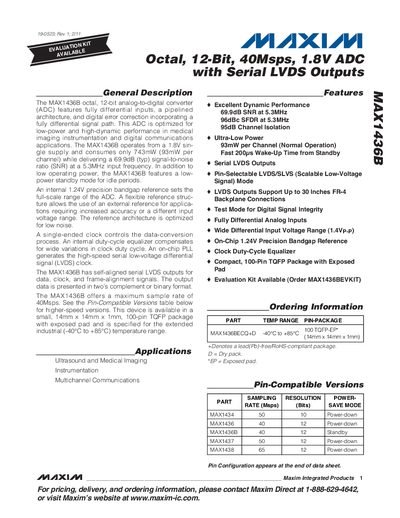
The MAX1436B is an octal, 12‑bit analog‑to‑digital converter optimized for low‑power, high‑dynamic‑range applications such as medical imaging and multichannel communications. It operates from a 1.8 V supply, consumes 743 mW total (93 mW per channel) and delivers up to 69.9 dB SNR at a 5.3 MHz input frequency. The device includes fully differential inputs, an internal 1.24 V band‑gap reference, and serial LVDS outputs selectable for LVDS or SLVS mode.
The ADC is offered in a 100‑pin TQFP‑EP package (14 mm × 14 mm × 1 mm) qualified for an extended industrial temperature range (‑40 °C to +85 °C). Ordering information, absolute maximum ratings, electrical and timing characteristics, and package thermal data are provided in the datasheet.
| Resolution | 12 bits |
|---|---|
| Maximum Sample Rate | 40 Msps |
| Power Consumption (normal operation) | 743 mW total (93 mW per channel) |
| Signal‑to‑Noise Ratio | 69.9 dB (typ) |
| Spurious‑Free Dynamic Range | 96 dB (typ) |
| Channel Isolation | 95 dB |
| Input Differential Voltage Range | 1.4 Vp‑p |
| Package | 100‑pin TQFP‑EP, 14 mm × 14 mm × 1 mm |
| Operating Temperature Range | ‑40 °C to +85 °C |
The MAX1436B can sample up to 40 Msps.
Each channel consumes about 93 mW in normal operation.
It provides self‑aligned serial LVDS (or SLVS) outputs for data, clock, and frame‑alignment signals.