
MAX11008 is a LDMOS power management chip for wireless base stations launched by MAXIM. It supports up to 5A output current and has two programmable gain analog input channels, two programmable gain current detection channels, two programmable gain temperature detection channels and two analog auxiliary input channels. It also integrates a 12-bit SAR ADC and 4K byte EEPROM, supports SPI and I2C communication interfaces.
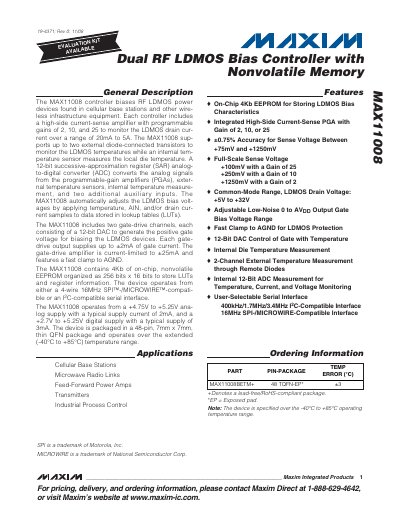
The MAX11008 controller biases RF LDMOS power devices used in cellular base stations and other wireless infrastructure. It includes a high‑side current‑sense PGA with programmable gains of 2, 10, or 25, a 12‑bit SAR ADC, two 12‑bit DACs for gate‑drive, and 4 Kb of non‑volatile EEPROM for lookup tables.
Key features include dual gate‑drive channels (±2 mA each), selectable SPI (16 MHz) or I²C interfaces, a 48‑pin thin QFN package, and operation over –40 °C to +85 °C. The device supplies analog power at +4.75 V to +5.25 V (typical 2 mA) and digital power at +2.7 V to +5.25 V (typical 3 mA).
| Analog supply voltage range | +4.75 V to +5.25 V |
|---|---|
| Digital supply voltage range | +2.7 V to +5.25 V |
| Analog supply current | typical 2 mA |
| Digital supply current | typical 3 mA |
| Package | 48‑pin, 7 mm x 7 mm thin QFN |
| Operating temperature range | -40 °C to +85 °C |
| ADC resolution | 12‑bit SAR |
| DAC resolution | 12‑bit |
| Gate‑drive output current | ±2 mA per channel |
| EEPROM size | 4 Kb (256 × 16 bits) |
It supports a 4‑wire 16 MHz SPI/MICROWIRE‑compatible interface or an I²C‑compatible serial interface.
The device contains 4 Kb of on‑chip EEPROM organized as 256 × 16 bits.
Each gate‑drive output can supply up to ±2 mA of gate current.
It operates from –40 °C to +85 °C.