
The MAX19527 is an octal 12-bit 50Msps ADC that operates from a single 1.8V supply and features low power consumption and high dynamic performance. It is ideal for medical imaging instrumentation and digital communications applications.
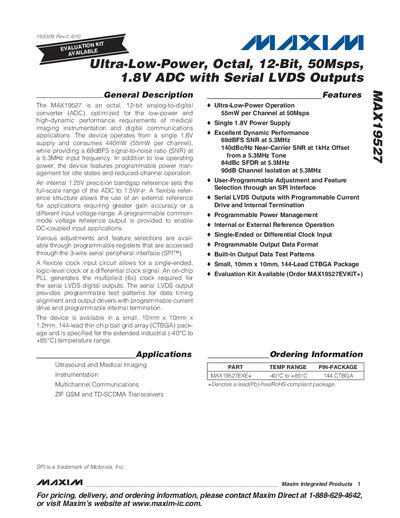
The MAX19527 is an ultra‑low‑power, 12‑bit, octal analog‑to‑digital converter optimized for medical imaging and digital communications. It operates from a single 1.8 V supply, consumes 55 mW per channel at 50 Msps, and delivers 69 dBFS SNR at a 5.3 MHz input.
The device is offered in a 144‑lead thin‑chip ball‑grid‑array (CTBGA) package (10 mm × 10 mm) and is rated for –40 °C to +85 °C operation. Detailed electrical characteristics, timing diagrams, and power‑management features are included, and additional package outlines are available on Maxim’s website.
| Resolution | 12 bits |
|---|---|
| Signal‑to‑Noise Ratio (SNR) | 69 dBFS at 5.3 MHz |
| Power Consumption per Channel | 55 mW (50 Msps) |
| Package | 144‑lead CTBGA, 10 mm × 10 mm |
| Operating Temperature Range | -40 °C to +85 °C |
| Maximum Clock Frequency | 50 MHz |
| Input Differential Range | 1.5 Vp‑p |
The device supports up to 50 Msps sampling rate.
It is offered in a 144‑lead thin‑chip ball‑grid‑array (CTBGA) package measuring 10 mm × 10 mm.
The typical signal‑to‑noise ratio is 69 dBFS at a 5.3 MHz input frequency.