
MAX109 is a 2.2Gsps, 8-bit analog-to-digital converter (ADC) that enables the accurate digitizing of analog signals with frequencies up to 2.5GHz.
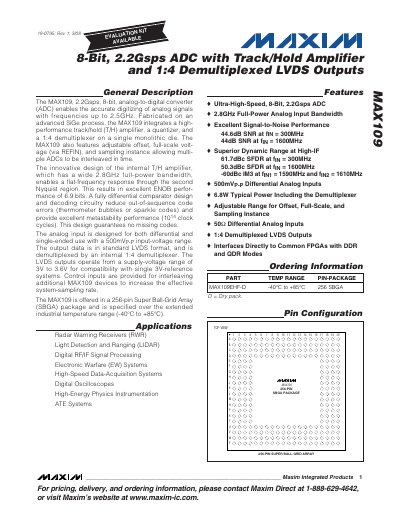
The MAX109 high‑speed ADC from Maxim integrates a track‑hold amplifier, quantizer and a 1:4 demultiplexer on a single die. It supports both differential and single‑ended inputs with a 500 mV P‑P range and delivers LVDS outputs that operate from 3.0 V to 3.6 V.
The device is offered in a 256‑pin Super Ball‑Grid Array (SBGA) package and is specified for an industrial temperature range of –40 °C to +85 °C. Typical power dissipation is 6.5–8.8 W, and the ADC achieves 44.6 dB SNR at 300 MHz with an ENOB of 6.9 bits.
| Resolution | 8 bits |
|---|---|
| Maximum Sample Rate | 2.2 Gsps |
| Full‑Power Input Bandwidth | 2.8 GHz |
| LVDS Output Voltage (100 Ω load) | 250‑400 mV |
| Supply Voltage for LVDS Outputs | 3.0 V – 3.6 V |
| Power Dissipation | 6.5 – 8.8 W |
| Effective Number of Bits (ENOB) | 6.9 bits |
| Operating Temperature Range | –40 °C to +85 °C |
| Package | 256‑pin Super Ball‑Grid Array (SBGA) |
The MAX109 can sample at up to 2.2 Gsps.
LVDS outputs operate from 3.0 V to 3.6 V.
Typical power dissipation is between 6.5 W and 8.8 W.
The analog input range is 500 mV peak‑to‑peak differential.