
The MAX2066 is a high-linearity digital variable-gain amplifier (VGA) designed to interface with 50Ω systems operating in the 50MHz to 1000MHz frequency range. It features a digital attenuator and amplifier, which can be controlled using either an SPI-compatible interface or a parallel bus. The device has a gain of 22dB, a noise figure of 5.2dB (including attenuator insertion loss), and a high OIP3 level of +42.4dBm. It is ideal for various receiver and transmitter applications.
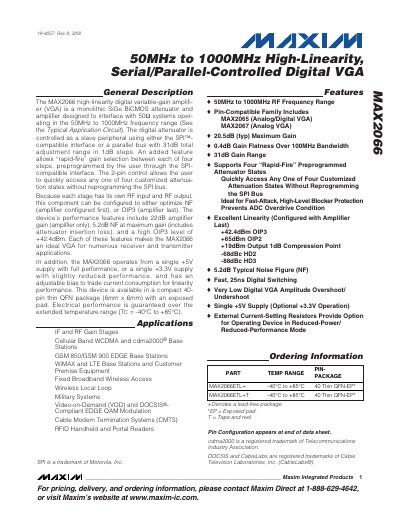
The MAX2066 is a SiGe BiCMOS digital variable‑gain amplifier (VGA) designed for 50 Ω systems operating from 50 MHz to 1 GHz. It offers a 31 dB total gain adjustment in 1 dB steps and supports rapid‑fire selection of four pre‑programmed attenuation states via an SPI‑compatible interface or a parallel bus.
The device operates from a single +5 V supply (or +3.3 V with reduced performance) and is available in a 40‑pin thin QFN package (6 mm × 6 mm). It provides high linearity (OIP3 up to +42.4 dBm) and low noise (typical NF 5.2 dB) across a wide temperature range of –40 °C to +85 °C.
| Frequency Range | 50 MHz – 1000 MHz |
|---|---|
| Gain Range | 31 dB total |
| Gain Step | 1 dB |
| Supply Voltage | +5 V (or +3.3 V optional) |
| Noise Figure | 5.2 dB (typical at max gain) |
| Output Third‑Order Intercept (OIP3) | +42.4 dBm |
| Package | 40‑pin thin QFN (6 mm × 6 mm) with exposed pad |
The MAX2066 provides a total gain adjustment range of 31 dB.
It can be controlled as a slave peripheral using either an SPI‑compatible interface or a parallel bus.
The device operates from a single +5 V supply, or from +3.3 V with slightly reduced performance.
The typical noise figure is 5.2 dB at maximum gain.