
The MAX19790 is a dual-channel analog voltage variable attenuator (VVA) designed for 50I systems operating in the 250MHz to 4000MHz frequency range. Each attenuator includes a control circuit that provides 22dB of attenuation range with a linear control slope of 10dB/V. Both attenuators share a common analog control and can be cascaded together to yield 44dB of total dynamic range, with a combined linear control slope of 20dB/V. The IC is a monolithic device designed on one of Maxim’s proprietary SiGe BiCMOS processes. The device operates from a single +5.0V supply and is available in a compact, 36-pin thin QFN package.
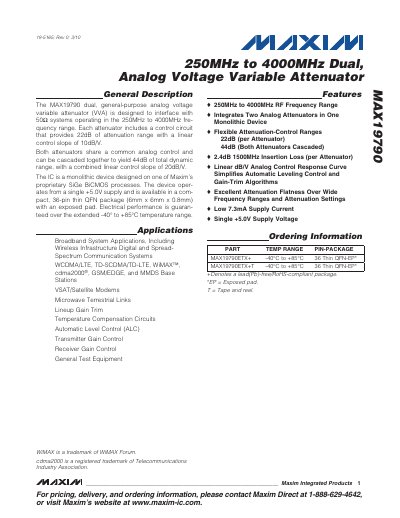
The MAX19790 is a dual, general‑purpose analog voltage variable attenuator (VVA) designed for 50 Ω systems covering 250 MHz to 4000 MHz. Each channel provides 22 dB of attenuation with a linear control slope of 10 dB/V, and the two channels can be cascaded for a total of 44 dB dynamic range.
The device runs from a single +5.0 V supply, draws about 7.3 mA typical supply current, and is offered in a 36‑pin thin QFN package (6 mm × 6 mm × 0.8 mm). It operates reliably from –40 °C to +85 °C and includes pins for RF input/output, control voltage, and an exposed pad for thermal grounding.
| Frequency range | 250 MHz – 4000 MHz |
|---|---|
| Attenuation per channel | 22 dB |
| Total attenuation (cascaded) | 44 dB |
| Supply voltage | +5.0 V |
| Typical supply current | 7.3 mA |
| Linear control slope | 10 dB/V per attenuator |
| Package | 36‑pin thin QFN (6 mm × 6 mm × 0.8 mm) |
| Operating temperature range | -40 °C to +85 °C |
The MAX19790 operates from a single +5.0 V supply.
Each channel provides 22 dB of attenuation; two channels cascaded give 44 dB total.
It is supplied in a 36‑pin thin QFN package measuring 6 mm × 6 mm × 0.8 mm.