
This document is an introduction to MAX2064, a high-linearity, serial/analog-controlled VGA operating in the 50MHz to 1000MHz frequency range. This component can be configured to either optimize noise figure (NF) (amplifier configured first) or OIP3 (amplifier last). The device's performance features include 24dB amplifier gain (amplifier only), 4.4dB NF at maximum gain (includes attenuator insertion losses), and a high OIP3 level of +41dBm. Each of these features makes the device an ideal VGA for multipath receiver and transmitter applications. In addition, the device operates from a single +5V supply with full performance, or a +3.3V supply for an enhanced power-savings mode with lower performance. The device is available in a compact 48-pin TQFN package (7mm x 7mm) with an exposed pad. Electrical performance is guaranteed over the extended temperature range, from TC = -40°C to +85°C.
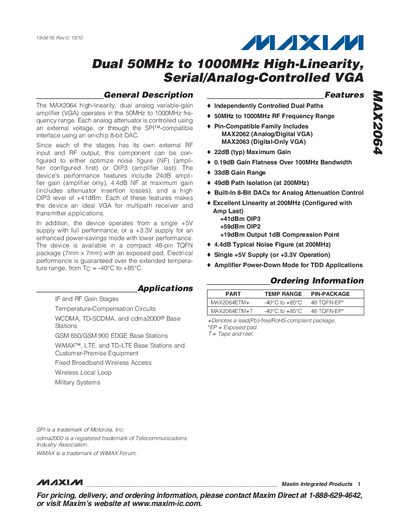
The MAX2064 is a dual analog variable‑gain amplifier operating from 50 MHz to 1000 MHz. Each path can be controlled via an external voltage or an SPI‑compatible 8‑bit DAC, allowing independent gain and attenuation settings.
The device is supplied by a single +5 V (or +3.3 V low‑power mode) and is offered in a 48‑pin TQFN‑EP package. Detailed electrical characteristics, absolute maximum ratings, and recommended operating conditions are provided for system designers.
| RF Frequency Range | 50 MHz – 1000 MHz |
|---|---|
| Maximum Gain | 22 dB (typ) |
| Noise Figure | 4.4 dB (typ at 200 MHz) |
| Third‑Order Intercept (OIP3) | +41 dBm |
The typical maximum gain is 22 dB.
The typical noise figure at 200 MHz is 4.4 dB.
The MAX2064 provides a third‑order intercept point of +41 dBm.