
S8380/S8381 series are designed to have higher sensitivity in the infrared and soft X-ray regions when compared to standard NMOS linear image sensors. The peak sensitivity wavelength is in the near IR region (λp=750 nm).
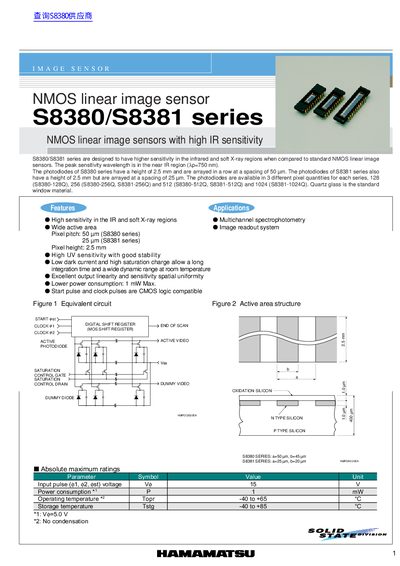
The S8380/S8381 series are NMOS linear image sensors designed for high infrared and soft‑X‑ray sensitivity. The photodiodes are 2.5 mm tall and are available with pixel pitches of 50 µm (S8380) or 25 µm (S8381) in 128, 256, 512 and 1024‑pixel formats. Quartz glass is used as the standard window material, and the devices operate with CMOS‑compatible start and clock pulses.
Key electrical characteristics include a maximum power consumption of 1 mW, operating temperature range from –40 °C to +65 °C, and very low dark current (0.1–0.6 pA). The datasheet provides absolute maximum ratings, recommended operating conditions, pin assignments, and typical spectral response curves.
| Pixel height | 2.5 mm |
|---|---|
| Power consumption (max) | 1 mW |
| Operating temperature range | -40 °C to +65 °C |
| Storage temperature range | -40 °C to +85 °C |
| Window material | Quartz glass |
| Photodiode dark current | 0.1–0.6 pA (depending on version) |
| Number of pixels available | 128, 256, 512, 1024 |
The sensors consume up to 1 mW of power.
They operate from –40 °C to +65 °C.
The standard window material is quartz glass.