
The HIN230-HIN241 family of RS-232 transmitters/receivers interface circuits meet all ElA RS-232E and V.28 specifications, and are particularly suited for those applications where ±12V is not available. They require a single +5V power supply (except HIN231 and HIN239) and feature onboard charge pump voltage converters which generate +10V and -10V supplies from the 5V supply. The HIN233 and HIN235 require no external capacitors and are ideally suited for applications where circuit board space is critical. The family of devices offer a wide variety of RS-232 transmitter/receiver combinations to accommodate various applications (see Selection Table).
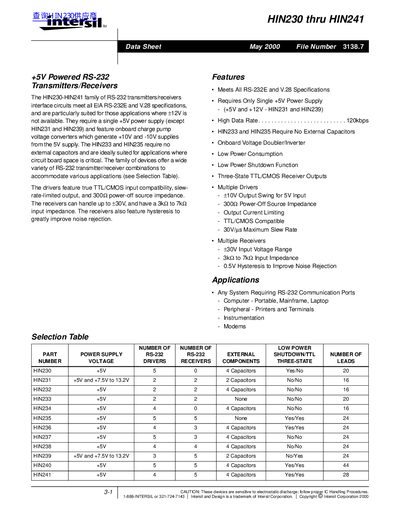
The HIN230‑HIN241 family of RS‑232 transmitters/receivers provides a single‑supply (+5 V) solution for RS‑232 communication when a +12 V rail is unavailable. Devices generate internal +10 V and –10 V supplies, offer true TTL/CMOS input compatibility, three‑state receiver outputs, low power consumption and a low‑power shutdown function. Various driver/receiver combinations are available to suit different applications, with data rates up to 120 kbps.
The datasheet includes a selection table, ordering information for multiple package types (SOIC, PDIP, MQFP, SSOP), detailed pin descriptions and pinout diagrams, as well as die characteristics such as dimensions (160 mil × 140 mil) and transistor count (238). Legal and warranty notices conclude the document.
| Supply voltage | +5 V (single, except HIN231 and HIN239 require +5 V and +12 V) |
|---|---|
| Maximum data rate | 120 kbps |
| Output swing (5 V input) | +10 V |
| Power‑off source impedance | 300 Ω |
| Maximum slew rate | 30 V/µs |
| Receiver input voltage range | up to +30 V |
| Receiver input impedance | 3 kΩ to 7 kΩ |
| Hysteresis | 0.5 V |
| Die dimensions | 160 mil × 140 mil |
| Transistor count | 238 |
All devices operate from a single +5 V supply, except HIN231 and HIN239 which need both +5 V and a +12 V rail.
The family supports data rates up to 120 kbps.
HIN233 and HIN235 require no external capacitors, making them suitable for space‑constrained designs.
The transmitter provides a +10 V output swing with a 5 V input supply.