
Intersil HS-26C31RH is a quad differential line driver designed for digital data transmission over balanced lines and meets the requirements of EIA standard RS-422. Radiation hardened CMOS processing assures low power consumption, high speed, and reliable operation in the most severe radiation environments. The HS-26C31RH accepts CMOS signal levels and converts them to RS-422 compatible outputs. This circuit uses special outputs that enable the drivers to power down without loading down the bus. Enable and disable pins allow several devices to be connected to the same data source and addressed independently.
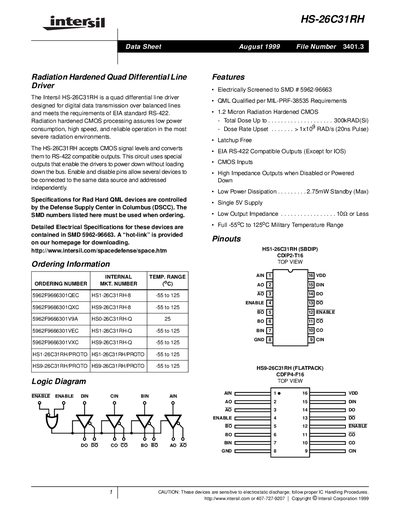
The HS-26C31RH is a quad differential line driver designed for digital data transmission over balanced lines and complies with the EIA RS‑422 standard. It uses radiation‑hardened CMOS processing to provide low power consumption, high speed, and reliable operation in severe radiation environments. Features include latch‑up free operation, high‑impedance outputs when disabled, and a single 5 V supply.
Key specifications are listed in the datasheet, including a total radiation dose tolerance of 300 kRAD(Si), a standby power dissipation of 2.75 mW (max), and an operating temperature range of –55 °C to 125 °C. Ordering information, pinout diagrams, and die dimensions are also provided.
| Total Radiation Dose | 300 kRAD (Si) |
|---|---|
| Dose Rate Upset | > 1×10⁹ RAD/s (20 ns pulse) |
| Standby Power Dissipation | 2.75 mW (max) |
| Operating Temperature Range | -55 °C to 125 °C |
| Supply Voltage | 5 V (single) |
| Output Impedance | ≤ 10 Ω |
| Package Dimensions | 96.5 mil × 195 mil × 21 mil |
It can tolerate up to 300 kRAD (Si).
The device consumes a maximum of 2.75 mW in standby.
It operates from –55 °C to 125 °C.
The driver requires a single 5 V supply.