
The TDR-400 is a handy, light impulse reflectometer, processor controlled, with LCD display for check and locate faults in telecommunication and power cables. Measuring principle: The measuring pulse fed into the cable will reflected by in homogeneity of the cable impedance (cable faults) and showed on the display. The distance and the kind of the fault can be determined out of the shape and the time setting of the reflection (Practical experience can be obtained by test measurements). If the cable is terminated with a resistance equal to the impedance of the cable, no reflexion occurs when the cable is faultless. In the case of breaks, contact faults in sleeves, short circuits or taps/splitter in the sector to be tested, the distance to the cable beginning can be determined by the pulse echo. If wide pulses are used for the measurement, the echoes are stronger, but faultless taps/splitter cause then strong echoes. Propagation factor The Propagation factor (nvp-value) declares the velocity of electrical signals in the cable in relation to the speed of light. The propagation factor of the cable under test must always preset before the length measurement. If the propagation factor is unknown, a approximate value is set and the fault is determined from both ends of the cable. Impulse Reflectometer FEATURES TDR-400 Measuring range 0 - 2000 m Resolution 0.25 m, 0.5 m, 1 m, 4 m Accuracy 0.2 % of the measuring range Propagation factor
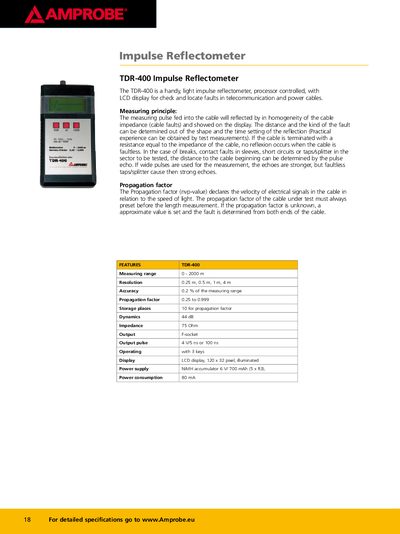
The TDR-400 is a handheld, processor‑controlled impulse reflectometer with an LCD display, designed to locate faults in telecommunication and power cables. It works by sending a measuring pulse into the cable and interpreting reflected signals to determine fault type and distance.
Key features include a measuring range up to 2000 m, selectable resolution, 0.2 % accuracy, adjustable propagation factor, and a 44 dB dynamic range. The device is powered by a 6 V NiMH accumulator (700 mAh) and offers an F‑socket output and configurable pulse widths.
| Measuring range | 0‑2000 m |
|---|---|
| Resolution | 0.25 m, 0.5 m, 1 m, 4 m |
| Accuracy | 0.2 % of range |
| Propagation factor | 0.25‑0.999 |
| Storage places for propagation factor | 10 |
| Dynamic range | 44 dB |
| Impedance | 75 Ω |
| Output connector | F‑socket |
| Output pulse width | 4/5 ns or 100 ns |
| Display | LCD 120 × 32 pixel, illuminated |
| Power supply | NiMH accumulator 6 V / 700 mAh |
| Power consumption | 80 mA |
A measuring pulse is injected into the cable and the reflected signal shown on the display indicates fault type and distance.
The propagation factor declares the signal velocity in the cable and must be set before length measurement.
The device can measure up to 2000 meters of cable.