
The document describes the specifications and performance characteristics of the 3049D and 3049D1 models, including weight, size, mounting, material, sensitivity, frequency range, resonant frequency, linearity, transverse sensitivity, strain sensitivity, environmental requirements, etc.
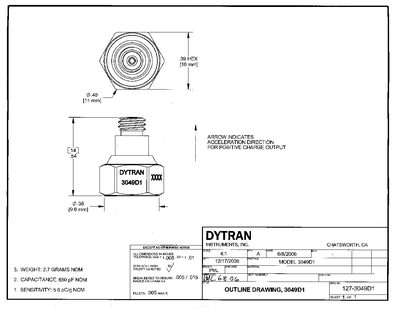
This specifications manual details the key characteristics of Dytran's 3049D and 3049D1 accelerometers, including dimensions, mounting options, and material construction. The document is intended for engineers and technicians who need precise sensor data for integration and testing.
Key performance figures such as sensitivity, frequency range, resonant frequency, and environmental limits are listed, along with electrical parameters like capacitance and output polarity. Physical attributes such as weight, size, and housing material are also provided.
| Weight (3049D) | 3.2 grams |
|---|---|
| Weight (3049D1) | 3.0 grams |
| Size (hex) | .39 (10 mm) × .54 inches |
| Mounting (3049D) | 10‑32 integral stud |
| Mounting (3049D1) | adhesive mount |
| Material | Titanium alloy |
| Sensitivity (3049D1) | 5.8 pC/g |
| Frequency range | +5 % to 8 kHz |
| Resonant frequency | 40 kHz |
| Temperature range | -100 °F to +350 °F |
| Capacitance | 650 pF |
| Output signal polarity | positive |
The 3049D1 sensor weighs 3.0 grams.
Its nominal sensitivity is 5.8 pC per g.
They operate from –100 °F up to +350 °F.
The 3049D1 uses an adhesive mount.