
MC10EP195/D is a 3.3V ECL programmable delay chip produced by Semiconductor Components Industries, LLC, which is mainly used for clock deskewing and timing adjustment.
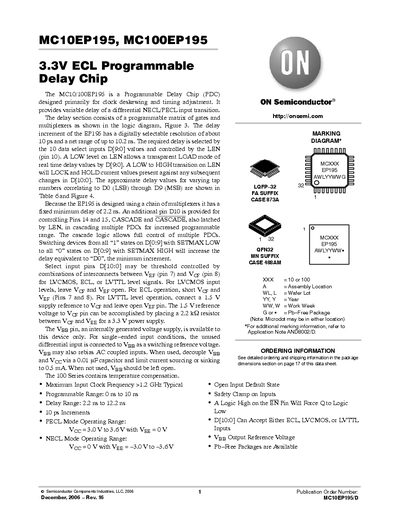
The MC10EP195 (and MC100EP195) is a 3.3 V ECL programmable delay chip designed for clock deskewing and timing adjustment. It provides a digitally selectable delay resolution of about 10 ps over a range up to 10.2 ns, with a fixed minimum delay of 2.2 ns. The device supports multiple input voltage modes (ECL, LVCMOS, LVTTL) and includes cascade pins for extending the programmable range.
The datasheet includes pin descriptions, control pin functions, electrical characteristics, maximum ratings, and package dimensions for both LQFP‑32 and QFN‑32 packages. It also lists ordering information, marking details, and compliance notes.
| Delay Increment | 10 ps |
|---|---|
| Programmable Delay Range | 0 ns to 10 ns |
| Total Delay Range | 2.2 ns to 12.2 ns |
| Maximum Input Clock Frequency | >1.2 GHz |
| Operating Temperature Range | -40 °C to +85 °C |
| Output Current (Continuous) | 50 mA |
The device has a fixed minimum delay of 2.2 ns.
The delay increment is approximately 10 ps per step.
The chip can handle input clock frequencies greater than 1.2 GHz.
It operates from –40 °C up to +85 °C.