
SN7002W is a N-channel enhancement mode logic level dv/dt rated small signal transistor with a maximum voltage of 60V, an RDS(on) of 5 ohms and an ID of 0.23 A.
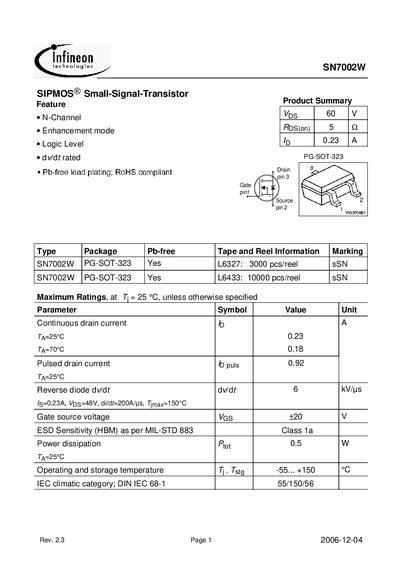
The Infineon SN7002W datasheet provides detailed specifications for the N‑channel enhancement‑mode SIPMOS transistor, including maximum ratings, thermal characteristics, and dynamic performance. It lists key parameters such as continuous drain current, breakdown voltage, gate threshold, and power dissipation.
Typical characteristic curves, capacitance values, and safe operating area diagrams are included to aid designers in selecting and applying the device in low‑voltage, high‑speed circuits. The document also contains packaging information and regulatory compliance notes.
| Continuous drain current (Id) | 0.23 A (Ta=25 °C) |
|---|---|
| Pulsed drain current (Id,puls) | 0.92 A (Ta=25 °C) |
| Drain‑source breakdown voltage (Vds) | 60 V |
| Output capacitance (Coss) | typical 7.2 pF |
| Power dissipation (Ptot) | 0.5 W (Ta=25 °C) |
The maximum continuous drain current is 0.23 A at a case temperature of 25 °C.
The SN7002W can withstand a drain‑source breakdown voltage of 60 V.
It can dissipate up to 0.5 W at a case temperature of 25 °C.