
This document describes the features and characteristics of Microchip Technology Inc.'s MCP2150 product, which implements the IrDA standard including various communication protocols and data transfer rates, and can easily interface with industry standard UARTs and infrared transceivers.
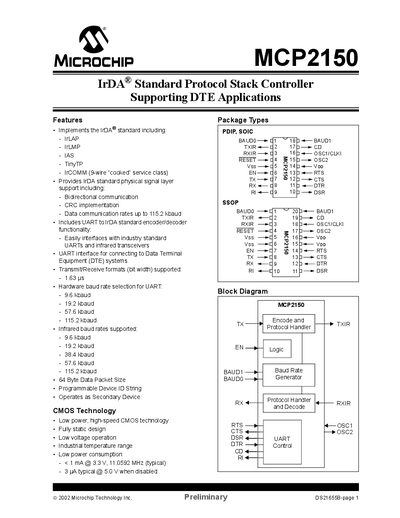
The MCP2150 is a low‑pin‑count (18‑pin) IrDA® standard protocol stack controller designed for Data Terminal Equipment (DTE) applications. It provides UART‑to‑IrDA encoding/decoding and supports point‑to‑point infrared communication.
The device offers selectable UART and infrared baud rates, low power CMOS operation, programmable device ID, and is available in PDIP, SOIC and SSOP packages. Pin descriptions, signal directions and timing requirements are provided for hardware designers.
| Pin count | 18‑pin |
|---|---|
| Package types | PDIP, SOIC, SSOP |
| Typical current consumption | <1 mA @ 3.3 V |
| Current when disabled | 3 pA @ 5.0 V |
| Operating temperature range | Industrial |
| Data packet size | 64 Byte |
| UART baud rates | 9.6, 19.2, 57.6, 115.2 kbaud |
| Infrared baud rates | 9.6, 19.2, 38.4, 57.6, 115.2 kbaud |
| Device ID string | Programmable |
| Technology | Low‑power CMOS |
The MCP2150 supports UART baud rates of 9.6, 19.2, 57.6 and 115.2 kbaud, and infrared baud rates of 9.6, 19.2, 38.4, 57.6 and 115.2 kbaud.
The serial baud rate is selected by the state of the BAUD1 and BAUDO pins.
Typical current consumption is less than 1 mA at 3.3 V (typical).
The MCP2150 is offered in PDIP, SOIC and SSOP packages.