
TLE6266G is a low-speed CAN transceiver for automotive applications, featuring low-power mode and low voltage drop regulator.
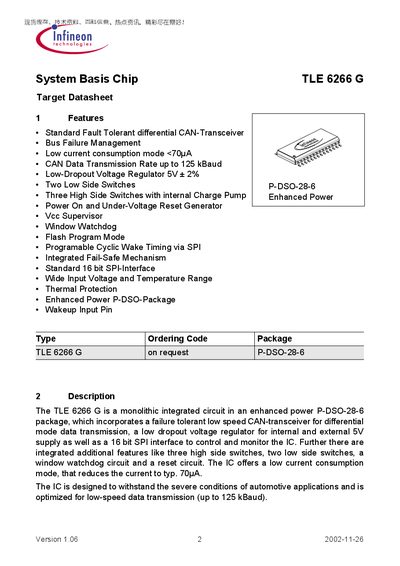
The TLE 6266 G is a monolithic system‑basis chip in an enhanced power P‑DSO‑28‑6 package. It integrates a fault‑tolerant low‑speed CAN‑transceiver, a low‑dropout 5 V regulator, a 16‑bit SPI interface, three high‑side switches, two low‑side switches, a window watchdog and various protection features. The device is designed for automotive applications and supports low‑current operation modes.
The datasheet provides detailed pin definitions, functional block diagrams, and descriptions of the four operation modes (normal, receive‑only, Vbat standby, and cyclic wake). It also lists electrical characteristics such as current consumption, CAN data rate, and voltage regulator tolerance.
| CAN transceiver type | Standard Fault Tolerant differential |
|---|---|
| Low‑current consumption mode | < 70 µA |
| CAN data transmission rate | up to 125 kBaud |
| Voltage regulator | 5 V ±2 % |
| Low side switches | Two |
| High side switches | Three |
| Watchdog | Window Watchdog |
| Package | Enhanced power P‑DSO‑28‑6 |
| Wake‑up input | Present |
The chip supports a CAN data transmission rate of up to 125 kBaud.
It contains three high‑side switches with an internal charge pump.
In low‑current mode the device draws less than 70 µA.
The chip is supplied in an enhanced power P‑DSO‑28‑6 package.