
ZL1505 is a synchronous step-down MOSFET driver from Intersil, which integrates a 5A, 0.5W low-side driver and a 3A, 0.8W high-side driver to support high step-down buck applications.
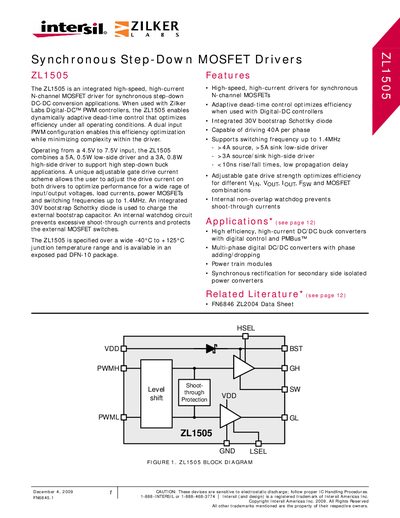
The ZL1505 is a high‑speed, high‑current N‑channel MOSFET driver designed for synchronous step‑down DC‑DC converters. It operates from a 4.5 V to 7.5 V input and includes adaptive dead‑time control, a 30 V bootstrap diode, and an internal watchdog to prevent shoot‑through currents.
The document details the pin configuration, absolute maximum ratings, electrical specifications, thermal protection limits, and typical performance curves. It also includes ordering information, package dimensions for the exposed‑pad DFN‑10 (3 mm × 3 mm) package, and a revision history.
| High‑side driver current | >4 A source, >5 A sink |
|---|---|
| Low‑side driver current | >3 A source/sink |
| Maximum switching frequency | 1.4 MHz |
| Package | DFN‑10, 3 mm × 3 mm |
| Operating temperature range | -40 °C to +125 °C |
| Thermal trip point | 150 °C |
| Bootstrap diode voltage | 30 V |
It is supplied in an exposed‑pad DFN‑10 package measuring 3 mm × 3 mm.
The device supports switching frequencies up to 1.4 MHz.
The high‑side driver can source >4 A and sink >5 A, while the low‑side driver can source and sink >3 A.