
ADG784 is a low power, high speed, low distortion, high switching speed 16-lead QSOP/SOIC package 2:1 switch device. It is suitable for 100VG-AnyLAN token ring 4Mbps/16Mbps ATM25/155 NIC adapters and hubs, audio and video switching, relay replacement and other applications.
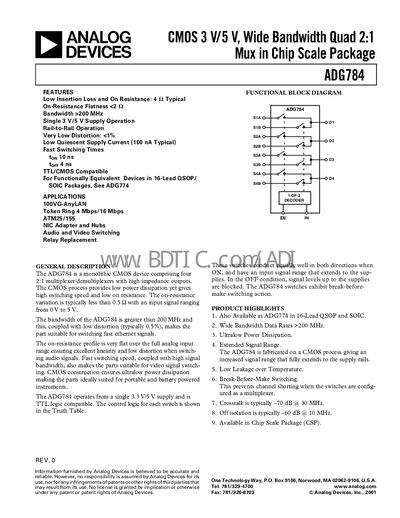
The ADG784 is a monolithic CMOS quad 2:1 multiplexer/demultiplexer offering low insertion loss, low on‑resistance (typ. 2.2 Ω) and a flat resistance profile across the full analog input range. It operates from a single 3 V or 5 V supply, is TTL/CMOS compatible, and provides rail‑to‑rail operation with very low distortion (<1%).
With a bandwidth greater than 200 MHz, low crosstalk (‑70 dB @30 MHz) and good off‑isolation (‑60 dB @10 MHz), the device is suitable for fast Ethernet, audio, video and other high‑speed signal switching applications. The part is offered in a chip‑scale package and includes ESD protection, requiring proper handling precautions.
| On‑Resistance (Ron) typical | 2.2 Ω |
|---|---|
| Bandwidth | >200 MHz |
| Input High Voltage (min) | 2.4 V |
| Input Low Voltage (max) | 0.8 V |
| Crosstalk (typ.) | -70 dB @30 MHz |
| Off Isolation (typ.) | -60 dB @10 MHz |
| Supply Voltage | 3 V or 5 V |
| Quiescent Supply Current (typ.) | 100 nA |
It operates from a single 3 V or 5 V supply.
The typical on‑resistance is 2.2 Ω.
The device has a bandwidth greater than 200 MHz.
Yes, it is an ESD‑sensitive device and requires proper handling precautions.