
Key facts
Start here
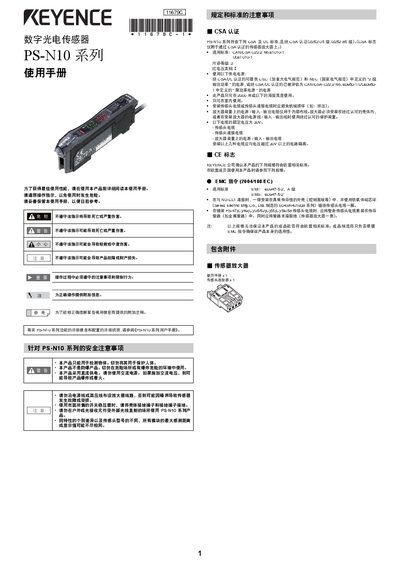
Keyence PS-N10 Series User Manual
This manual covers safety precautions, installation guidelines, wiring diagrams, and calibration procedures for the PS‑N10 series photo‑electric sensor and its amplifier. It explains how to mount the sensor, connect power and signal lines, and set up the device for various measurement modes.
The document also includes troubleshooting tips, power and output specifications, environmental limits, and warranty information. Users can follow the step‑by‑step instructions to ensure reliable operation in industrial applications. This manual is written in Japanese.
Keyence PS-N10 Series specifications
| Maximum Output Power | 860 mW (24 V) |
|---|---|
| Maximum Signal Current | 100 mA |
| Operating Temperature Range | -20 °C to +55 °C |
| Weight | 75 g |
All Keyence PS-N10 Series documents by type
Day-to-day operation, settings and troubleshooting. Start here if the product is already set up.
Questions answered in these manuals
Is the PS‑N10 series explosion‑proof?
No, the PS‑N10 series is not an explosion‑proof product and must not be used in explosive atmospheres.
What grounding method is recommended for the sensor?
Connect the sensor’s grounding terminal and the grounding screw to a proper ground when installing.
What power supply should be used with the PS-N10 Series?
Use a CSA/UL certified power supply that provides Class 2 output as defined in the CEC and NEC, or one evaluated as a Limited Power Source.
From: Keyence FS-N11P / PS-N10 Series Photoelectric Sensor Instruction Manual
Which CSA and UL standards does the PS-N10 Series comply with?
It complies with CAN/CSA C22.2 No.61010-1 and UL61010-1, and has been certified by CSA (Class 2252 05 / Class 2252 85).
From: Keyence FS-N11P / PS-N10 Series Photoelectric Sensor Instruction Manual