
Key facts
- Brand
- Delta
- Model
- DTE10P
- Documents
- 2
- Languages
- ZH
- Last added
- 2012-01-01
Start here
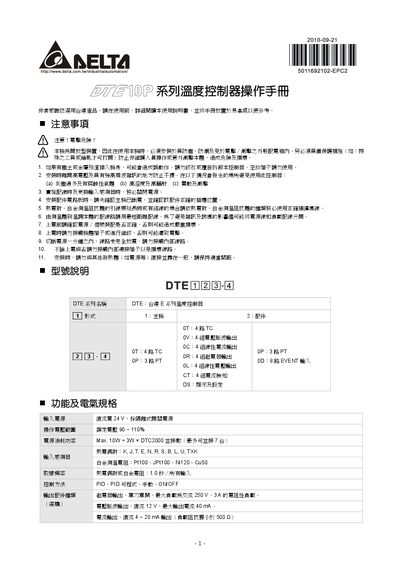
Delta DTE10P Series Temperature Controller User Manual
The Delta DTE10P series temperature controller provides multi‑channel temperature measurement, PID, ON‑OFF and manual control modes, and supports a variety of sensor types such as Pt100, JPt100, Ni120 and Cu50. It offers up to 12 output channels (OUT1, OUT2, SUB1, SUB2) and includes RS‑485 Modbus communication for integration with DTC2000/DTC2001 expansion units.
The manual covers safety precautions, installation on DIN rails, electrical specifications, configuration of input filtering, alarm settings, CT and EVENT functions, as well as programmable PID and hot‑runner control. Detailed register tables and communication protocols are provided for advanced users and service technicians. This manual is written in Chinese.
Delta DTE10P specifications
| Input Power | DC 24 V |
|---|---|
| Power Consumption | Max 10 W + 3 W × DTC2000 |
| Supported Sensors | Pt100, JPt100, Ni120, Cu50 |
| Analog Voltage Output | 0 ~ 10 V |
| Current Output | 4 ~ 20 mA |
| RS‑485 Baud Rate | 2 400 ~ 115 200 bps |
| Relative Humidity | 35 % ~ 85 % RH (no condensation) |
Source: Delta DTE10P Series Temperature Controller User Manual
All Delta DTE10P documents by type
Day-to-day operation, settings and troubleshooting. Start here if the product is already set up.
Questions answered in these manuals
What temperature sensor types can be connected to the DTE10P controller?
The controller supports Pt100, JPt100, Ni120 and Cu50 temperature sensors.
From: Delta DTE10P Series Temperature Controller User Manual
Which communication protocol and baud rates are available?
It uses RS‑485 Modbus communication with selectable baud rates from 2 400 to 115 200 bps.
From: Delta DTE10P Series Temperature Controller User Manual
Which communication protocol is supported?
The controller uses Modbus protocol in RTU or ASCII format over RS‑485.
How can PID power‑on memory be enabled?
Write 1234H to address 47F1H and then 0008H to address 4824H to activate the programmable PID power‑on storage function.