
Key facts
- Brand
- DELL
- Model
- PowerEdge R720
- Category
- Servers Computer
- Documents
- 2
- Languages
- EN
- Last added
- 2023-11-24
Start here
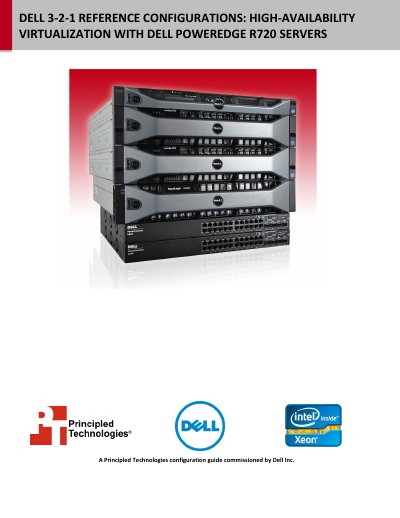
Dell PowerEdge R720 Server 3-2-1 Reference Configuration Guide
This Dell configuration guide, commissioned by Dell Inc. and produced by Principled Technologies, describes the Dell 3-2-1 Reference Configuration for high-availability virtualization. It centers on Dell PowerEdge R720 servers with Intel Xeon E5-2680 processors, plus a Dell PowerEdge R620 management server, two Dell PowerConnect 6224 switches, and a Dell EqualLogic PS6100XV storage array.
The guide explains that the 3-2-1 design uses three servers, two switches, and one storage array to keep infrastructure running during hardware failure. It includes setup procedures for the management server, switches, storage, ESXi hosts, vCenter clusters, networking, and virtual machines running SQL Server, Exchange Server, and SharePoint Server.
Dell PowerEdge R720 specifications
| Processors | two Intel Xeon processors E5-2680 |
|---|---|
| Form factor | 2U rack server |
| Storage chassis | 8-bay and 16-bay chassis |
| Memory | up to 768 GB of RAM |
| Consolidation ratio | greater than 15:1 |
Source: Dell PowerEdge R720 Server 3-2-1 Reference Configuration Guide
All Dell PowerEdge R720 documents by type
Mounting, wiring and first power-up. Read it before the hardware goes in.
Questions answered in these manuals
What servers are used in the Dell 3-2-1 Reference Configuration?
Two Dell PowerEdge R720 servers host virtual machines, and a Dell PowerEdge R620 serves as the management server.
From: Dell PowerEdge R720 Server 3-2-1 Reference Configuration Guide
What does the 3-2-1 design consist of?
It consists of three servers, two switches, and one storage array.
From: Dell PowerEdge R720 Server 3-2-1 Reference Configuration Guide
How many users did the 3-2-1 configuration support per VM?
The 3-2-1 base configuration supported 500 users per VM.
How many users did the 4-2-2 configuration support per VM?
The 4-2-2 configuration supported 1,500 users per VM.