
Key facts
- Brand
- Dallas Semiconductor
- Model
- DS1963S
- Industry
- Industrial
- Documents
- 2
- Languages
- ZH
- Last added
- 2012-07-03
Start here
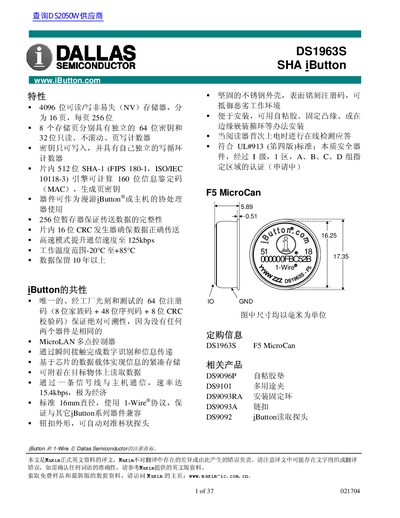
Maxim Integrated DS1963S SHA iButton Datasheet
The DS1963S is a financial iButton featuring SHA-1 functionality and multiple read/write data areas. It allows for the creation of public and private data micro-databases within its non-volatile memory. The device includes a 512-bit SHA-1 engine capable of calculating 160-bit Message Authentication Codes (MACs). Data is transmitted serially via the 1-Wire protocol, requiring only one signal line and ground. A single DS1963S can be used for four mutually independent applications, such as secure electronic wallets for local transport systems, pay phones, parking management, or vending machines. It can also act as a co-processor to assist the host in calculating signatures.
The device features a 64-bit laser-etched ROM, a 256-bit scratchpad, 8 pages of 32-byte general-purpose SRAM, 8 write-cycle counter-protected 32-byte SRAM pages, and two 32-byte pages storing eight 64-bit keys. It operates in a temperature range of -20°C to +85°C and retains data for over 10 years. The DS1963S is available in a MicroCan package and supports parasite-powered operation. This manual is written in Chinese.
Dallas Semiconductor DS1963S specifications
| Memory Capacity | 4096 bits |
|---|---|
| Memory Pages | 16 pages |
| SHA-1 Engine | 512 bits |
| MAC Size | 160 bits |
| Operating Temperature | -20°C to +85°C |
| Data Retention | 10 years |
| Communication Speed | 125kpps |
| Package Type | MicroCan |
All Dallas Semiconductor DS1963S documents by type
Day-to-day operation, settings and troubleshooting. Start here if the product is already set up.
Ratings, dimensions and ordering codes, for selection and design work.
Questions answered in these manuals
What is the DS1963S?
The DS1963S is a financial iButton with SHA-1 functionality and multiple read/write data areas.
How does the DS1963S transmit data?
Data is transmitted serially via the 1-Wire protocol, requiring only one signal line and ground.