
ROHM BD18397RUV-M/BD18398RUV-M 2-channel/3-channel automotive buck LED driver with SPI dimming, LIMP-HOME mode and protection features.
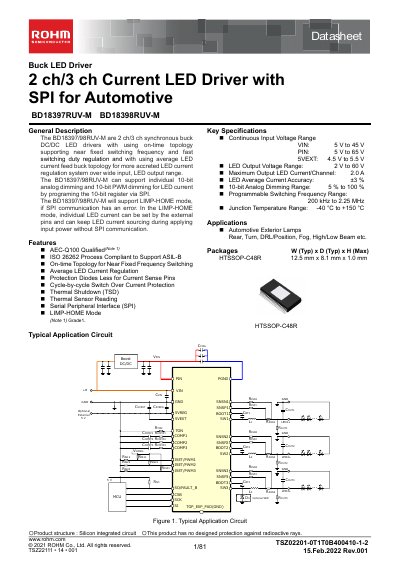
The BD18397RUV-M and BD18398RUV-M are 2-channel and 3-channel synchronous buck DC/DC LED drivers for automotive use. They use on-time topology and average LED current regulation, with 10-bit analog and 10-bit PWM dimming programmed through SPI. A LIMP-HOME mode allows LED current to be set by external pins if SPI communication has an error.
Key ratings include a 5 V to 45 V continuous VIN range, 5 V to 65 V PIN range, 2 V to 60 V LED output voltage, and 2.0 A maximum LED current per channel. The document also covers pin assignments, block diagram, absolute maximum ratings, thermal resistance, and the HTSSOP-C48R package.
| Continuous Input Voltage Range VIN | 5 V to 45 V |
|---|---|
| PIN Supply Voltage Range | 5 V to 65 V |
| LED Output Voltage Range | 2 V to 60 V |
| Maximum Output LED Current per Channel | 2.0 A |
| LED Average Current Accuracy | ±3 % |
| 10-bit Analog Dimming Range | 5 % to 100 % |
| Programmable Switching Frequency Range | 200 kHz to 2.25 MHz |
| Junction Temperature Range | -40 °C to +150 °C |
| Package | HTSSOP-C48R, 12.5 mm x 8.1 mm x 1.0 mm |
The continuous VIN range is 5 V to 45 V, and the PIN supply range is 5 V to 65 V.
The BD18397RUV-M is a 2-channel device and the BD18398RUV-M is a 3-channel device.
The devices support individual 10-bit analog dimming and 10-bit PWM dimming for LED current via SPI registers.
The device supports LIMP-HOME mode, where LED current can be set by external pins without SPI communication.